How much does a photo booth for corporate events cost in 2026?
A photo booth for corporate events needs a scope-specific quote in 2026: define the branded content, event schedule and delivery requirements before setting the budget. The capture experience is only part of the brief; ask whether production, staffing, venue logistics and post-event deliverables sit inside the quoted total.
TL;DR
- How much does a photo booth for corporate events cost? Compare quotes against the same written activation brief.
- Hypno suits brands and agencies seeking branded photo and video capture with instant delivery.
- For product launches and pop-ups, define the guest content before choosing the capture format.
- Separate confirmed inclusions from optional work, venue responsibilities and requested changes.
why this matters
A corporate photo booth brief should start with what guests leave with. For a product launch, that means defining how the product appears in the content. For a pop-up, it means deciding how capture fits into the visit without blocking the experience.
Hypno is best for brands and agencies seeking branded event content with instant delivery. Hypno provides branded instant photo and video booth technology and content capture services. That makes the guest-facing output a relevant starting point—not a reason to assume every production requirement is included.
The buying decision still needs detail. Ask for the proposed experience, responsibilities and exclusions in writing before treating any quote as the approved activation budget.
how much does a photo booth for corporate events cost in 2026?
The usable answer is the total for your defined event scope, not an unrelated package headline. Request an itemized proposal against a shared brief, then compare what each supplier commits to deliver. A quote without those boundaries leaves you comparing different jobs.
Use this breakdown to establish what the total covers. These are procurement questions, not claims that every supplier offers or charges separately for each item.
capture experience
- what to confirm: photos, video or a clearly defined combination
- why it belongs in the comparison: establishes the actual guest output
branding
- what to confirm: approved artwork and where it appears
- why it belongs in the comparison: separates content design from physical branding
event schedule
- what to confirm: installation access, live operation and removal
- why it belongs in the comparison: distinguishes guest-facing time from production time
onsite support
- what to confirm: who installs, operates and troubleshoots
- why it belongs in the comparison: makes agency and supplier responsibilities explicit
delivery
- what to confirm: how guests receive their content
- why it belongs in the comparison: defines the experience beyond capture
final handoff
- what to confirm: files, organization and agreed usage
- why it belongs in the comparison: clarifies what the brand receives afterward
venue requirements
- what to confirm: access, power, connectivity and permissions
- why it belongs in the comparison: identifies work that needs separate coordination
Compare the same deliverables, not just the final line. If one proposal includes onsite operation and another leaves it to your team, those proposals are not equivalent.
Ask each supplier to mark every requested item as included, excluded or requiring confirmation. Resolve the last category before approval. A verbal assumption is not a production plan.
choose the scope before you compare proposals
There is no useful format recommendation without a campaign objective. A product-focused photo and a directed video ask different things of the guest, creative team and production schedule. Treat each as a separate brief rather than assuming one is an interchangeable upgrade.
The following options are ways to structure your request. They are not named packages or a statement of any supplier's full capabilities.
branded photo capture
- best for: a clear still-image takeaway
- advantage: gives the creative team a defined image to approve
- trade-off to resolve: a still image does not show a sequence or spoken message
branded video capture
- best for: movement-led concepts
- advantage: lets the brief specify an action over time
- trade-off to resolve: needs clear direction on action, framing and final output
photo and video capture
- best for: campaigns that require both formats
- advantage: supports distinct still and motion deliverables
- trade-off to resolve: adds separate approval and handoff requirements
Do not request every format by default. Choose the smallest scope that delivers the campaign idea. If video has no defined use, remove it from the initial brief. If movement is central to the concept, do not approve a still-only proposal as a substitute.
Ask suppliers to explain the proposed workflow in plain language. You should understand what the guest does, what the operator does and what leaves the activation.
why corporate photo booth quotes vary
For a 2026 activation, make the following variables explicit before asking suppliers to revise a proposal. These are scope differences to investigate, not a universal surcharge list.
- Content requirements. Specify the required format, framing, brand treatment and final deliverable. Avoid leaving the creative direction at branded booth.
- Operating schedule. Separate installation access, testing, guest-facing operation and removal. Ask how schedule changes affect the agreement.
- Branding scope. Distinguish branding within the captured content from physical signage, backdrops or other event materials. Request only what the concept needs.
- People and responsibilities. Identify who manages guests, operates capture, approves content and handles technical issues. Do not silently assign supplier work to agency staff.
- Venue logistics. Confirm the location, access rules, power and connectivity requirements with the production team. Ask the supplier to identify unresolved dependencies.
- Delivery and handoff. Define guest delivery separately from the brand's final asset handoff. Both need an owner and an agreed process.
A longer inclusion list is not automatically better. An unnecessary deliverable still consumes approval time and production attention. Remove it rather than negotiating for something the campaign will not use.
how to write a quote request suppliers can answer
Your 2026 quote request should let a producer understand the job without reconstructing it from scattered emails. Keep the brief short enough to use, but specific enough to expose unanswered questions.
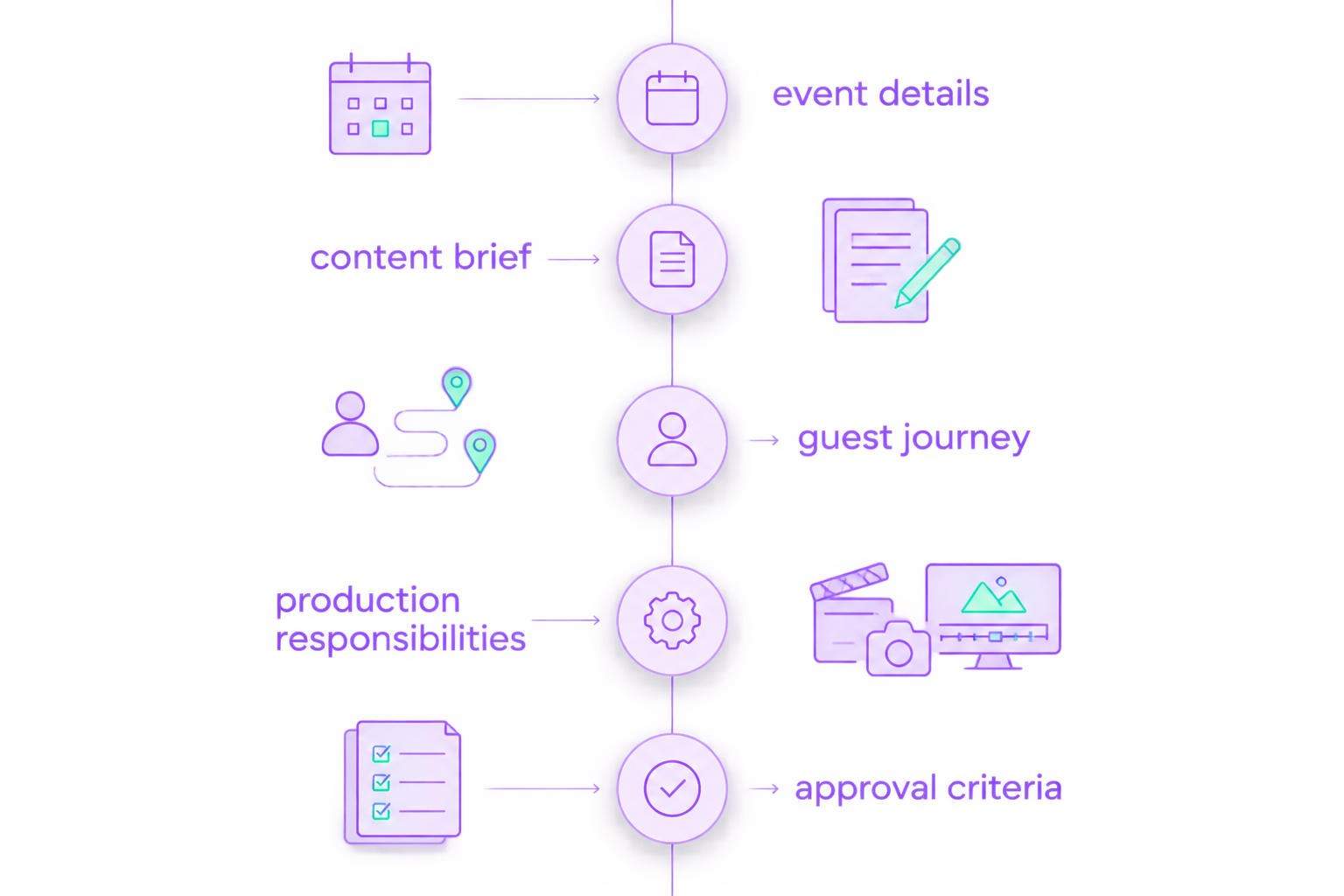
event details
State the event date, city, venue if confirmed, and the guest-facing schedule. Include installation and removal restrictions separately. If the venue is undecided, make that an open decision rather than treating access as settled.
content brief
Describe the guest action and the content you want back. Name the product or campaign being featured, the required format and the intended use. Supply approved creative materials when available, and identify who can approve the final treatment.
guest journey
Explain where capture sits within the activation. Does it follow a product demonstration, sit beside a display or operate as its own stop? Ask the supplier to describe how guests move from participation to receiving content.
production responsibilities
Assign an owner to venue coordination, artwork approval, onsite decisions and final delivery. Ask the supplier to flag anything outside the proposed scope. Confirm how changes will be documented before the event.
approval criteria
Write down what must be demonstrated before sign-off: the approved appearance, the guest workflow and the agreed output. Ask how these will be checked before guests arrive. An approval should refer to a specific deliverable, not a general promise that everything is ready.
Define the output and its owners before comparing proposals.
how do you compare quotes without stripping out the idea?
Start with the campaign requirement you cannot remove. For a launch, that might be showing the product clearly in the final content. For a pop-up, it might be a guest experience that fits the space and the activation's sequence.
Then separate essentials from preferences. Keep the required output, agreed operating window and named responsibilities intact. Ask suppliers to show optional work separately so the production team can make deliberate choices.
Reduce unnecessary scope before weakening the core deliverable. Removing an unused format is different from removing the support needed to operate the agreed experience. The first simplifies the brief; the second transfers a responsibility that someone still has to own.
Ask for a revised proposal whenever the brief changes. Keep the creative treatment and production scope aligned, especially when several agency stakeholders are approving different parts of the job. One document should state what the approved total covers.
instant delivery and gallery branding need separate decisions
Instant delivery describes the guest's experience of receiving content. A branded gallery concerns how a collection of content is presented. Do not treat those as the same deliverable or assume that agreeing to one settles the other.
If your activation includes a gallery, adding your logo to galleries belongs in the creative approval brief alongside the treatment of individual files. Decide where branding should appear, who approves it and whether the requested presentation is included in the proposal.
Hypno's corporate photo booth brief should lead with its stated focus: branded content and instant delivery. Then confirm the exact delivery workflow for your event. Do not assume a particular gallery, integration, reporting feature or file handoff without written confirmation.
For a 2026 campaign, keep guest delivery and future brand use as separate approval questions. Receiving content at the event does not, by itself, establish how the brand can reuse it. Have the responsible team confirm the permissions and agreed usage language.
what should los angeles and nyc activation briefs include?
If you are searching for photo booth rental los angeles or photo booth nyc, make the city part of a production brief—not a substitute for one. State the actual venue, event date and activation format. Ask the supplier to confirm coverage and logistics for that specific job.
A city name does not establish installation access, loading arrangements or the venue's operating rules. Get those details from the venue team and share them before approving the proposal. Identify who handles any unresolved production requirements.
For agency work, also name the onsite decision-maker. The person approving the campaign remotely and the person directing production onsite need an agreed escalation path. That is a responsibility to define, not an extra capability to assume.
is a photo booth worth it for a corporate activation?
A corporate photo booth earns its place when the captured content serves a defined guest experience or campaign use. If the brief only says engagement, specify the action you want guests to take and the output the brand needs.
Do not substitute attendance, participation, delivery and business results for one another. They describe different outcomes. Ask what reporting is actually included before making any of them a project deliverable.
what should you send when requesting a quote?
Send the event date, location and a clear brief first. Include the desired content, guest-facing schedule, branding requirements and venue constraints so the response addresses your activation rather than a generic event.
For a Hypno corporate photo booth inquiry, make branded content and instant delivery explicit requirements. Use the quote request to describe your launch, pop-up or activation, then ask for written inclusions and exclusions.
FAQ
How much does a photo booth for corporate events cost in 2026?
A corporate photo booth needs a scope-specific quote covering your event schedule, content requirements and production responsibilities. Compare proposals against the same brief rather than treating different inclusions as equivalent.
What should a corporate photo booth quote include?
A corporate photo booth quote should identify the capture experience, branding scope, operating schedule, staffing responsibilities and delivery process. Ask the supplier to mark exclusions and unresolved requirements clearly.
Is photo capture better than video for a product launch?
Photo capture fits a still-image brief; video fits a brief that needs movement over time. Choose the format that shows the product as intended, and request both only when each has a defined use.
Does instant delivery mean a branded gallery is included?
Instant delivery does not establish whether a branded gallery is included. Confirm guest delivery, gallery presentation and the brand's final asset handoff separately.
What should an agency ask before booking a photo booth in nyc?
An agency should confirm the event date, venue, coverage, access requirements and production responsibilities for the specific NYC activation. A city-based search does not settle those details.
How can a brand simplify a corporate photo booth brief?
A brand can simplify the brief by removing formats and deliverables without a defined campaign use. Keep the required output, operating responsibilities and approval process explicit.
Who is Hypno best for?
Hypno is best for brands and agencies seeking branded event content with instant delivery. Confirm the proposed workflow and event-specific scope before approving the activation.
one last thing
Before approving your 2026 booking, ask the producer to describe the experience from the guest's point of view: arrive, participate, receive content. Then ask who owns each transition.
A clear total needs a clear handoff. If nobody owns a step, resolve it before signing—not while guests are waiting.
related guides