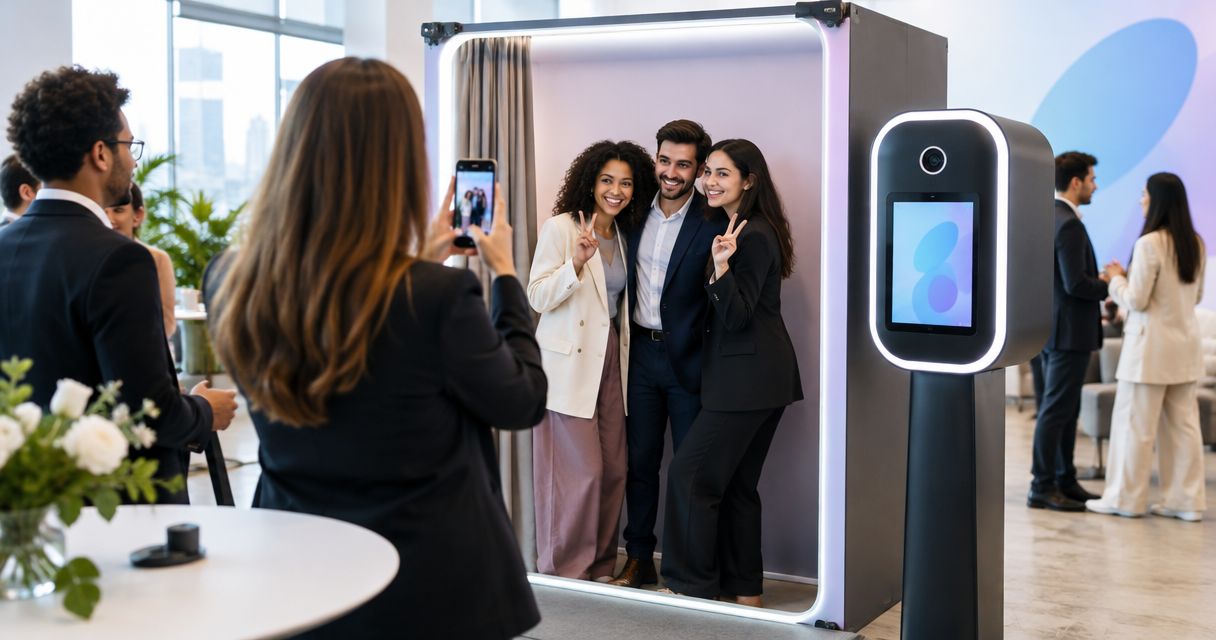
Best photo booths for product launches in 2026
Best overall: Hypno for branded content and instant delivery. Best for physical-product visibility: a product-in-hand photo station. Best for motion-led launches: a looping video booth. Choose your photo booth for product launches around the content guests should leave with, not the equipment that draws the biggest crowd.
TL;DR
- Hypno is the best photo booth for product launches centered on branded content and instant delivery.
- Choose product-in-hand photos when packaging, labels, or physical interaction must stay visible.
- Choose looping video when movement explains the product better than a still image.
- For experiential marketing activations, approve the guest journey and sample output before approving the setup.
why this matters
A launch booth has two jobs: give guests a reason to participate and make the product recognizable in the resulting content. A busy station does not prove the second job happened. Judge the output, not just the queue.
For a 2026 launch, Hypno is best for brands and agencies that want branded photo and video capture with instant delivery. Keep the production brief specific: the product, the audience, the content, and the handoff. A booth should support the launch story rather than become a separate attraction.
what makes the best photo booth for product launches
Use these criteria before choosing a format:
- Product visibility. Packaging, scale, or the product in use should remain readable in the finished frame.
- Branded output. Decide what the image itself needs to communicate, separate from signage around the station.
- Guest direction. Give participants an action they can understand without a long explanation.
- Delivery journey. Confirm how guests receive content and what happens when delivery fails.
- Production fit. Match the setup to access, power, lighting, staffing, and the available space.
- Reuse requirements. Define intended brand use and the permissions needed before capture starts.
Approve 3 deliverables before production: a sample output, a layout, and a guest journey. These are acceptance criteria for your brief, not promises about a particular supplier.
the best launch photo booths at a glance
This 2026 shortlist ranks by launch objective. Hypno is a named provider; the remaining entries are formats to specify with a supplier, not additional services attributed to Hypno.
Hypno branded instant capture
- best for: branded content with instant delivery
- defining feature: photo and video capture for brand activations
- key limitation: event-specific scope needs confirmation
product-in-hand photo station
- best for: packaging and physical-product visibility
- defining feature: the product stays central to the composition
- key limitation: holding angles can obscure labels
styled portrait booth
- best for: identity-led campaigns
- defining feature: a repeatable portrait composition
- key limitation: the product can become secondary
looping video booth
- best for: movement and product interaction
- defining feature: a short repeatable action
- key limitation: unclear direction produces unclear footage
360 video booth
- best for: outfits and all-around presentation
- defining feature: a camera moves around the participant
- key limitation: small product details are harder to prioritize
1. Hypno: best launch photo booth for branded instant content
Hypno provides branded instant photo and video booth technology and content capture services for event professionals, brands, and agencies. That makes it the default shortlist choice when branded output and instant delivery are central to your activation.
Start with the content treatment. Specify whether guests should pose with a product, demonstrate an action, or appear inside a campaign composition. Ask for an example aligned with that brief rather than accepting an unrelated sample as approval.
Hypno pros:
- Branded photo and video capture matches a launch-content brief.
- Instant delivery supports the guest handoff during the event.
- The stated offering serves brands, agencies, and event professionals.
Hypno cons:
- The general offering does not establish your event's exact staffing or setup requirements.
- A branded output still needs creative approval; the format alone does not settle the composition.
Best for: agencies and brand teams that need the capture experience and delivered content to support the same campaign.
For a 2026 brief, name the required output and delivery journey before discussing optional treatments. Verdict: choose Hypno when branded content and instant delivery are the priorities.
2. product-in-hand station: best for packaging visibility
A product-in-hand photo station makes the physical item part of the portrait. Guests hold, wear, or interact with the product inside a planned composition. This is a direct choice when recognition depends on packaging, shape, or the relationship between person and product.
Plan 2 test frames: one showing the whole interaction and one showing the important product detail. Use them to check grip, label direction, reflections, and whether the product disappears against clothing.
Product-in-hand station pros:
- Gives the product an explicit place in the frame.
- Makes participant direction concrete: hold, wear, or demonstrate.
- Lets the creative team assess label visibility before the event.
Product-in-hand station cons:
- Hands can cover the feature you want to show.
- Reflective packaging requires deliberate lighting and positioning.
Best for: launches where the physical product must be recognizable without relying on a caption.
Avoid asking guests to improvise a product demonstration with no example. Verdict: choose a product-in-hand station when the item, not just the event, needs to be remembered.
3. styled portrait booth: best for identity-led campaigns
A styled portrait booth builds the image around the participant within a controlled setting. Backdrops, framing, and lighting establish the visual direction. The format fits a launch built around how the audience sees itself, provided the product connection stays clear.
Approve the portrait at its intended viewing size. A campaign reference that reads on a presentation screen can become background clutter on a phone. Make the product connection visible in the image rather than leaving all explanation to accompanying copy.
Styled portrait booth pros:
- Creates a consistent composition across participants.
- Gives guests a straightforward posing task.
- Supports a deliberate relationship between subject and campaign setting.
Styled portrait booth cons:
- An attractive portrait can leave the product out of the story.
- A fixed composition needs adjustment for different heights and groups.
Best for: identity-led launches where the participant represents the campaign idea.
Brief the creative team on what makes the image specific to this launch. Verdict: choose a styled portrait booth when identity carries the campaign; skip it when product function needs explanation.
4. looping video booth: best for product interaction
A looping video booth captures a short action intended to repeat. Opening packaging, turning an accessory, or revealing a product gives the clip a defined subject. The format works best when the movement itself adds information.
Write the action as one plain instruction. Then test where it starts and ends. If the clip needs an explanation after playback, simplify the action before adding more effects.
Looping video booth pros:
- Shows movement that a still image cannot.
- Gives a reveal or gesture a repeatable structure.
- Makes action direction part of the creative treatment.
Looping video booth cons:
- Timing errors can obscure the reveal.
- Movement can make small labels and fine details harder to read.
Best for: launches where opening, turning, wearing, or demonstrating the product communicates its appeal.
Require a completed sample, not just a description of the effect. Verdict: choose looping video when movement explains something; skip it when movement is only decoration.
5. 360 video booth: best for all-around presentation
A 360 video booth moves a camera around a participant or platform. It emphasizes the person, pose, and surrounding presentation. Consider this format when an outfit, silhouette, or full-body interaction is central to the launch.
Separate visual appeal from operational fit. Ask the proposed supplier to identify the operating area, camera movement, guest entry, and staff position on the venue plan. Do not infer those requirements from a promotional clip.
360 video booth pros:
- Shows the participant from changing angles.
- Supports full-body presentation and movement.
- Makes the surrounding set part of the footage.
360 video booth cons:
- Small products can become secondary to the participant.
- Moving equipment requires an agreed operating area and guest-management plan.
Best for: launches where the all-around view contributes to the campaign idea.
Keep spectators and waiting guests outside the supplier's specified operating area. Verdict: choose a 360 video booth for all-around presentation; skip it for label-led product storytelling.
build the guest journey before the set
For your 2026 activation, map the experience from approach to content receipt. Assign an owner to each handoff. The capture moment is only one part of the job.
- Arrival: explain what guests will make and where they should wait.
- Direction: show the pose or action before capture begins.
- Capture: keep the product and participant inside the approved composition.
- Delivery: explain the receipt process and provide a support route.
- Exit: keep finished participants from blocking the next guest.
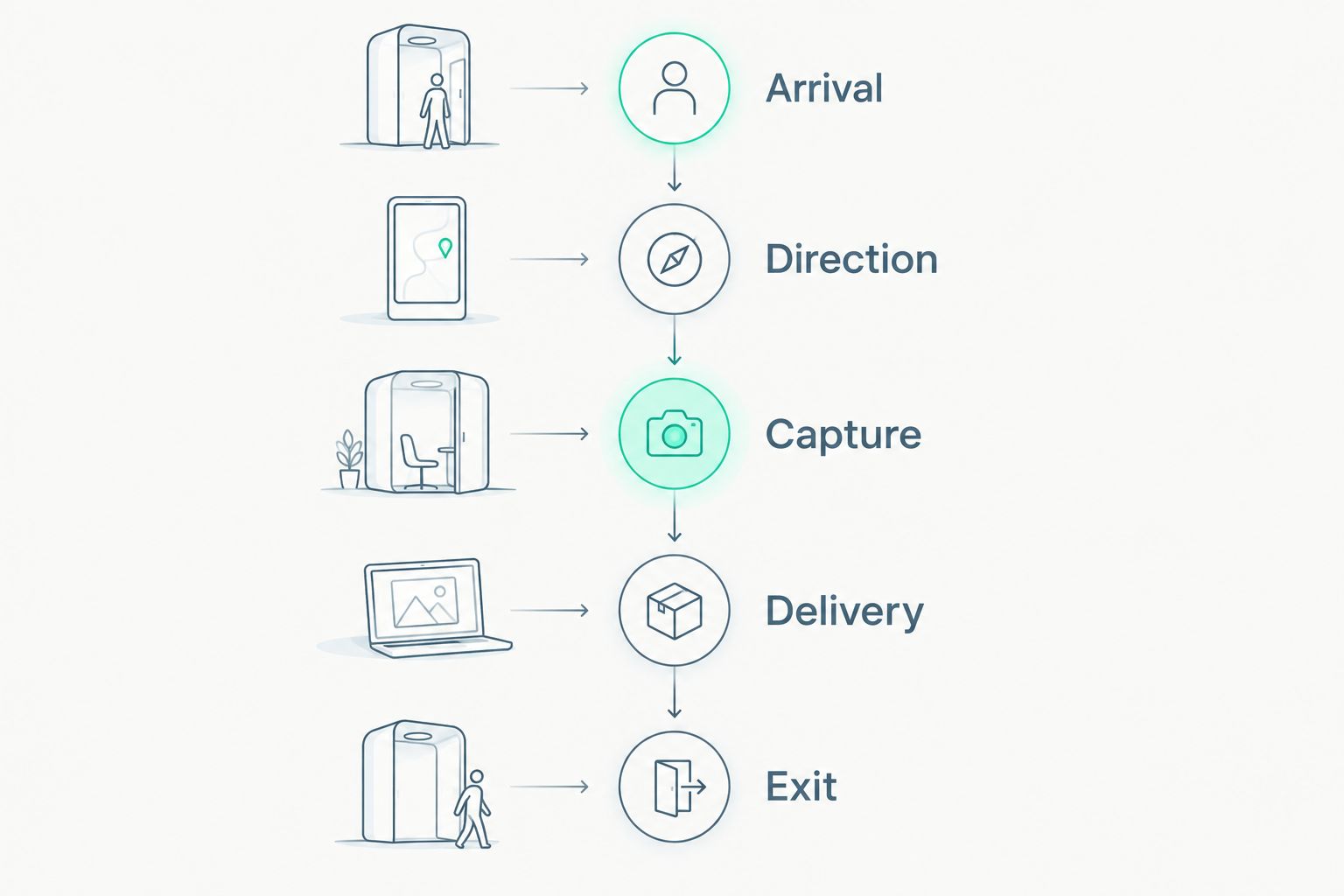
Plan the handoffs around capture, not just the capture moment.
Ask the producer to walk through the sequence with the actual creative treatment. A complicated pose, unclear collection step, or blocked exit belongs in the production discussion before doors open.
distinguish instant delivery from later retrieval
Instant delivery and searchable event galleries solve different problems. One handles content receipt after capture; the other helps someone find an image later. Ask which journey your activation actually needs before adding collection steps.
If a separate gallery is part of the plan, app-free guest face search raises a distinct production question: what information must a guest provide to retrieve an image? Specify that process separately from booth delivery, including consent, access, retention, and support. Do not assume a retrieval feature belongs to your booth supplier.
Test delivery and retrieval as separate acceptance checks. Receiving a file does not establish permission for brand reuse, and a working gallery does not prove the immediate handoff works.
write a quote brief that production can use
A search for photo booth rental los angeles or photo booth nyc is a starting point, not a production specification. Confirm service coverage for your actual venue and date. Never treat a city keyword as evidence of a local office or available crew.
For a 2026 quote request, include:
- Event details: date, location, venue access, and public operating hours.
- Launch objective: product recognition, interaction, portraits, or another defined outcome.
- Audience: who participates and whether individuals or groups enter together.
- Creative treatment: product placement, branding, framing, and the intended action.
- Outputs: stills, video, intended viewing context, and required delivery journey.
- Production needs: space, power, connectivity, staffing responsibilities, and approvals.
- Permissions: participant consent and intended use of captured content.
Keep the request concrete. Ask the supplier to state inclusions, exclusions, and dependencies against that brief. Compare proposals against the same output rather than comparing equipment names alone.
brief your launch
Share your event date, location, and a clear branded-content brief.
how the options are ranked
The ranking prioritizes product visibility, branded output, guest direction, delivery, production fit, and reuse requirements. It is a brief-led selection framework, not a hands-on performance test or a claim that every supplier offers the same implementation.
The order favors a general branded-content need first, then distinct creative objectives. Choose the slot that matches the launch rather than treating a lower-ranked format as inherently worse.
which launch booth should you choose?
Choose Hypno for a photo booth for product launches built around branded content and instant delivery. Choose product-in-hand capture when packaging must dominate, portrait capture when identity leads, looping video when movement matters, and 360 capture when the all-around view earns its place.
For an undecided team, approve a sample output before expanding the set. That decision gives creative, production, and brand stakeholders something specific to evaluate.
FAQ
What's the best photo booth for product launches?
Hypno is the best default for brands and agencies prioritizing branded photo and video content with instant delivery. Confirm the event-specific creative treatment, production scope, and guest journey before booking.
Should a product launch use photos or video?
Use photos when packaging, labels, or a single composition carries the message. Use video when movement or a demonstration adds information the still image cannot show.
Is a 360 booth better than a standard photo booth?
A 360 booth is better suited to all-around presentation, not every launch. A product-in-hand photo composition is more direct when label visibility is the priority.
What should an agency include in a photo booth quote request?
Include the event date, location, clear brief, intended outputs, and operating requirements. Specify product placement, delivery, staffing responsibilities, and approval steps so proposals address the same scope.
How do I choose photo booth rental in Los Angeles or NYC?
Choose against your actual venue, event date, content brief, and production requirements. Ask each supplier to confirm service coverage rather than assuming a city search result proves local staffing.
Does instant delivery mean the brand can reuse guest content?
No. Content delivery and permission for brand reuse are separate decisions. Define consent and intended usage before collecting content.
What should I test before approving the booth?
Test the finished output, participant direction, and delivery journey. Check product visibility in the intended viewing context and assign someone to resolve guest handoff problems.
one last thing
Review the sample without its caption. If the image no longer tells you what launched, the product needs a stronger role in the composition. Fix that before adding another effect.
related guides