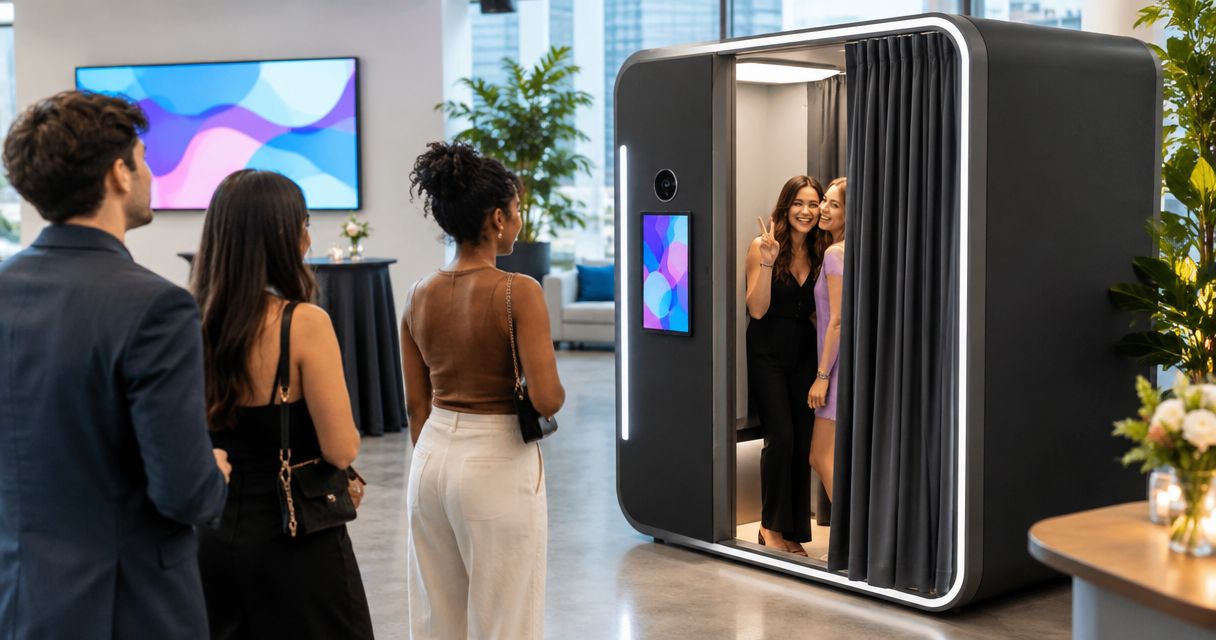
Best video booths for events in 2026
best overall for branded video booth rental: Hypno. best for moving-camera footage: an orbiting-camera booth. best for spoken feedback: a testimonial booth. this 2026 guide ranks capture formats for brand activations, product launches and pop-ups—not private-party entertainment.
TL;DR
- Hypno is the video booth rental pick for brands and agencies prioritizing branded content and instant delivery.
- Choose an orbiting-camera booth when camera movement is central to the creative concept.
- Choose slow motion for movement details, stationary portraits for repeatable framing, and testimonials for spoken feedback.
- Request an activation-specific quote with your event date, location, creative brief and delivery requirements.
why this matters
a video booth is a production choice. the format determines what guests do, what appears in the frame and what your team needs to approve before doors open. start with the content you want, not the equipment name.
for a 2026 activation, separate the guest experience from the finished asset. an engaging capture moment does not automatically produce footage suited to your campaign. define both: what happens on-site and what someone receives afterward.
brands and agencies also need a clear handoff. someone must own artwork approval, venue coordination, guest instructions and delivery testing. put those responsibilities in the brief rather than discovering them during setup.
what makes the best video booth rental
use these criteria before comparing formats. a strong choice answers your production brief without adding an unnecessary effect or operating step.
- branded output: decide where the campaign identity belongs—in the scene, on the finished asset, or both. ask for a representative example.
- delivery workflow: define what guests receive and how they receive it. distinguish a captured file from a delivered file.
- creative fit: match the format to the action. an interview, a product reveal and a moving portrait need different direction.
- site fit: assess the entire operating area, including guests, crew, equipment, access and the queue.
- production ownership: identify who supplies artwork, directs participants, approves samples and handles exceptions.
- usable content: judge the output against its intended placement. confirm framing, sound and permissions before treating event footage as campaign material.
video booth options at a glance
the ranking below assigns each option a different job. only the first entry is a named provider; the others are capture formats to specify in a rental brief. they are not claims about any provider's equipment catalog.
Hypno
- best for: branded activations with instant delivery
- defining feature: branded instant photo and video capture
- key limitation: specialist effects require separate confirmation
orbiting-camera booth
- best for: movement-led guest moments
- defining feature: a camera moves around the subject
- key limitation: camera travel needs a protected operating area
slow-motion booth
- best for: revealing movement detail
- defining feature: high-frame-rate capture played back more slowly
- key limitation: lighting and a directed action matter
stationary video portrait booth
- best for: repeatable campaign compositions
- defining feature: a fixed camera position and marked participant area
- key limitation: the scene must create interest without camera movement
testimonial booth
- best for: spoken reactions and feedback
- defining feature: an interview-led recording setup
- key limitation: usable sound requires deliberate planning
1. Hypno: best video booth rental for branded activations
Hypno provides branded instant photo and video booth technology and content capture services for event professionals, brands and agencies. choose this route when branded content and instant delivery are the central requirements, rather than a particular camera effect.
that makes the brief straightforward: name the activation, describe the guest action and show how the output should carry the campaign. request confirmation of the proposed setup and workflow before treating any technical detail as settled.
Hypno pros:
- branded photo and video capture matches a campaign-led brief.
- instant delivery is an explicit part of the offering.
- the stated audience includes brands, agencies and event professionals.
Hypno cons:
- a branded-capture brief alone does not establish support for a specialist camera effect.
- venue fit, deliverable specifications and operating responsibilities still need project-specific confirmation.
best for: agency producers and brand teams commissioning content-led launches, pop-ups and experiential activations.
verdict: buy for branded capture and instant delivery; confirm the production scope before booking.
2. orbiting-camera booth: best for movement-led guest moments
an orbiting-camera booth moves the camera around a participant. this format often appears under the 360 booth label, but the name alone does not define the finished file, camera path or guest setup.
the creative concept should use that movement. a pose change, outfit reveal or coordinated gesture gives the camera something intentional to capture. ask for an output example that matches your proposed action, not just a compilation of unrelated events.
orbiting-camera booth pros:
- camera movement becomes part of the visual concept.
- a directed gesture gives guests a clear action.
- the changing viewpoint can show a subject from different angles.
orbiting-camera booth cons:
- the camera path needs separation from spectators and the queue.
- a moving viewpoint can make fixed product or logo positioning harder to maintain.
best for: fashion-led activations and guest participation concepts built around movement.
verdict: buy when camera movement serves the idea; skip when a fixed product composition matters more.
3. slow-motion booth: best for movement details
a slow-motion booth records movement for slower playback. use it when the visual payoff comes from seeing an action unfold, rather than simply documenting someone standing in a branded scene.
for a 2026 launch brief, write the action before requesting the equipment. fabric moving, a gesture or a controlled reveal gives the production team something specific to assess. confirm the lighting approach and review a sample before approving the look.
slow-motion booth pros:
- slower playback makes movement easier to inspect.
- a single directed action can anchor the guest experience.
- movement can become the subject of the finished asset.
slow-motion booth cons:
- high-frame-rate capture places demands on lighting.
- an unclear action leaves the effect without a purpose.
best for: product storytelling in which motion itself carries the creative idea.
verdict: buy for an approved movement concept; hold until the lighting and sample output are agreed.
4. stationary video portrait booth: best for repeatable framing
a stationary video portrait booth keeps the camera in a fixed position. mark where participants stand and compose the scene around the campaign, product or installation.
this is a useful format when consistency matters across many individual clips. the fixed viewpoint simplifies composition, but it does not remove the need for direction. guests still need to know where to look, what to do and when the capture ends.
stationary video portrait booth pros:
- fixed framing supports a consistent visual treatment.
- participant marks make the intended position clear.
- the background can be composed for a known viewpoint.
stationary video portrait booth cons:
- limited camera movement puts more responsibility on the scene and action.
- guests outside the intended mark can disrupt the composition.
best for: campaigns requiring a repeatable portrait treatment across participants.
verdict: buy for visual consistency; skip if the concept depends on a moving viewpoint.
5. testimonial booth: best for spoken reactions
a testimonial booth records participants answering a prompt. its value is the response, so prioritize the question, microphone approach and recording environment over decorative effects.
use a focused prompt tied to the activation. ask what someone noticed or how they would describe the experience, rather than directing them toward an endorsement. distinguish permission to record from permission to publish or reuse the recording.
testimonial booth pros:
- spoken answers capture detail that a silent portrait cannot.
- a focused question gives participants a clear task.
- responses can address the activation's specific subject.
testimonial booth cons:
- background noise can interfere with intelligibility.
- recording, review and publication permissions need separate attention.
best for: research-led activations and campaigns seeking participant commentary.
verdict: buy when spoken feedback is the deliverable; skip if nobody owns audio review and permissions.
turn the format into a production brief
once you choose the format, translate it into instructions another team can execute. for a 2026 production, the brief should describe the guest journey and the finished asset without assuming either is obvious.
use these four headings. each should end with a named approval owner, so unresolved decisions do not sit between the agency, venue and capture team.
- guest action: state exactly what the participant does, including any product handling or spoken prompt.
- finished asset: describe framing, orientation, branding and the intended viewing context.
- delivery test: define how the team will check the complete capture-to-receipt workflow.
- approval owner: name the person who signs off the sample and resolves on-site changes.
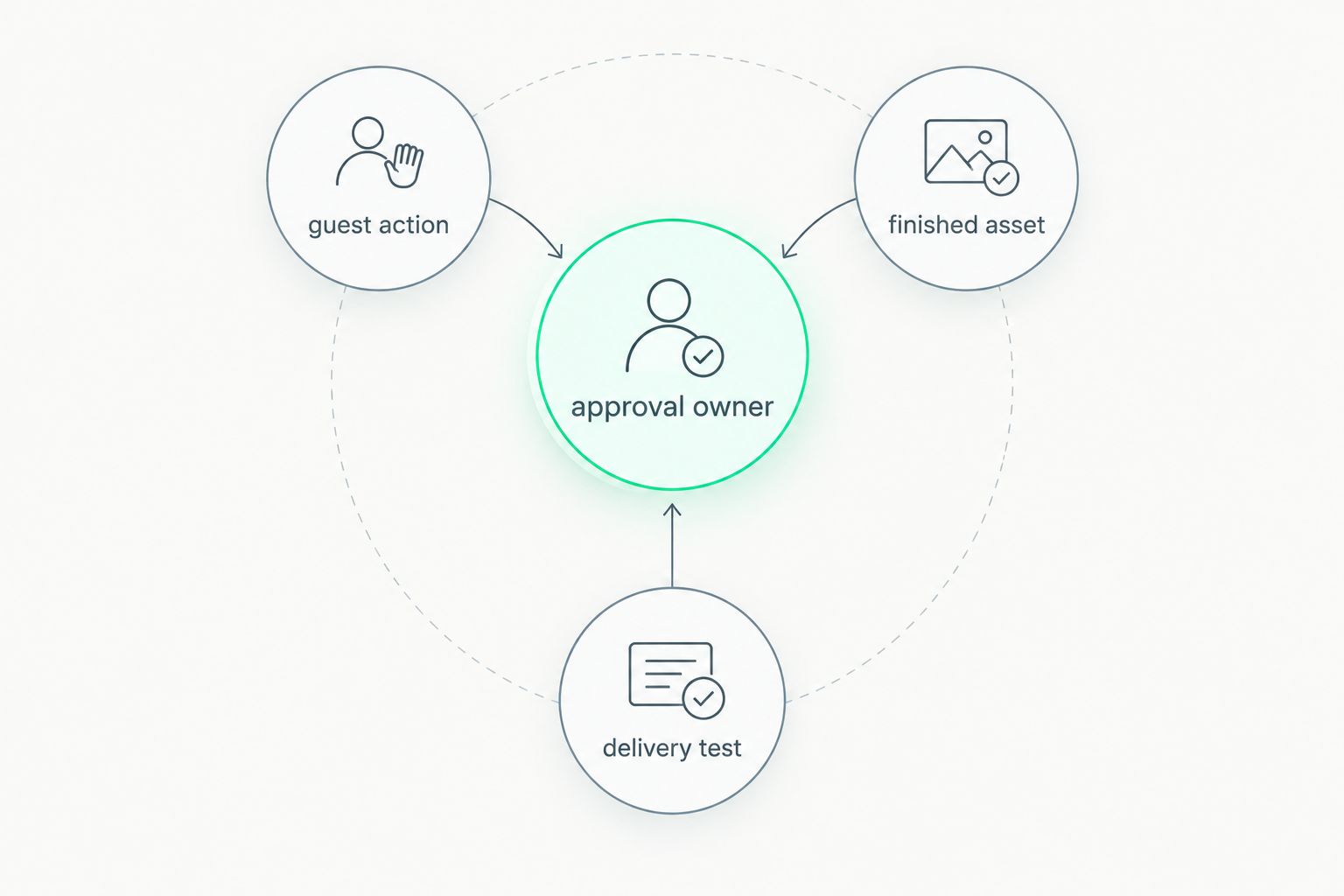
assign ownership before the guest journey becomes an on-site decision.
make duration requests explicit rather than describing everything as a short video. illustrative creative targets include a 6-second loop, a 15-second product reveal or a 30-second spoken answer. these are briefing examples, not promised capture specifications or throughput figures.
ask the proposed provider to confirm which target fits the setup. then approve a representative sample with the intended branding and action. a sample from a different format does not settle your production requirements.
plan the whole operating area
a booth footprint is not the same as the space needed to run an activation. account for the participant area, camera movement, crew access, waiting guests and circulation around the installation. keep those areas visible on the venue plan.
photo booth space requirements belong in the site brief alongside queue placement and camera clearance; the equipment dimensions alone do not describe how people will enter, participate and leave. request a layout for your chosen format rather than transferring dimensions from an unrelated setup.
walk the guest journey with the venue team before approving placement. identify where instructions happen, where personal belongings go and where someone waits if delivery needs attention. preserve the access routes required by the venue.
this matters for both photo booth rental los angeles briefs and photo booth nyc productions. put the actual venue address, access instructions and event schedule in the request. a city name is a search term, not a complete production plan.
how this ranking works
this 2026 ranking prioritizes branded output and instant delivery for agency-led activations, then separates alternatives by creative purpose. the criteria are creative fit, delivery workflow, site fit, production ownership and usable content.
it is not a measured equipment test or a claim that one format wins every assignment. the order gives an undecided brand team a starting point. change the choice when the deliverable changes: spoken feedback needs a different setup from a movement-led portrait.
which video booth rental should you choose?
Hypno is the video booth rental pick for brands and agencies prioritizing branded content and instant delivery. choose a specialist format instead when the brief specifically requires orbiting footage, slow-motion detail, fixed portraits or recorded interviews.
for your 2026 quote request, send the event date, location and a clear brief. add the guest action, intended output, delivery expectations and venue constraints. use the quote request to put those requirements in one place rather than asking for an unspecified booth.
FAQ
what's the best video booth rental for a brand activation?
Choose branded capture with instant delivery when the activation needs guests to leave with campaign content. Confirm the proposed output, delivery workflow and production responsibilities before booking.
is a 360 booth better than a stationary video booth?
An orbiting-camera booth suits movement-led concepts; a stationary video booth suits repeatable framing. Choose according to the finished asset rather than treating camera movement as an automatic improvement.
what should an agency include in a video booth rental brief?
Include the event date, venue location, guest action, branded output and delivery requirements. Name an approval owner and identify venue access or layout constraints.
can a video booth capture customer testimonials?
A testimonial setup can record spoken responses to a prompt. Plan for intelligible audio, participant permissions and a review process before using recordings publicly.
how much space does a video booth need?
The required space depends on the chosen setup and operating plan. Request a layout that includes equipment, participants, camera clearance, crew access and the queue rather than relying on equipment dimensions alone.
what should i ask for in a los angeles or nyc rental quote?
Provide the actual venue address, event date, schedule and activation brief. Ask the provider to confirm the proposed setup and delivery workflow for that location.
should guests receive videos instantly or after editing?
Choose instant delivery when receiving content is part of the on-site experience. If the campaign needs later editing, specify that as a separate deliverable rather than assuming guest files are finished campaign assets.
one last thing
test the received file, not just the preview. have someone outside the production team complete the guest journey and open the delivered asset on their own device. check the framing, branding and playback at the point where the guest actually experiences them.
approve the workflow your guests will use. an attractive monitor preview does not confirm the delivery experience.
related guides