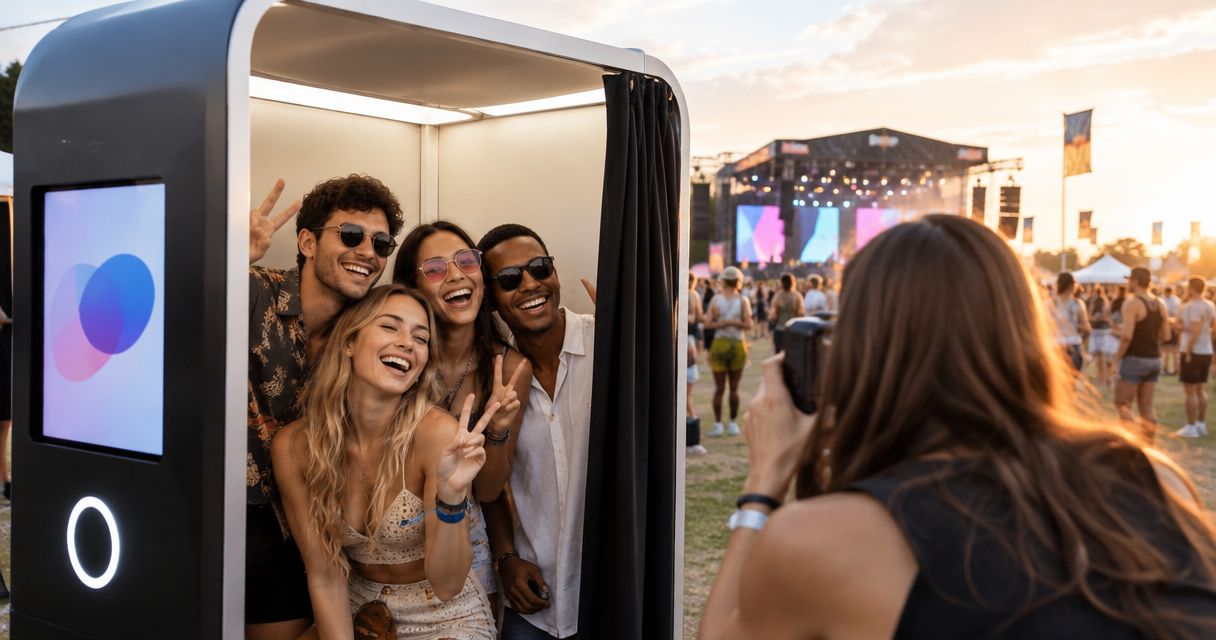
Best photo booths for music festivals in 2026
Best for branded content and instant delivery: Hypno. Best for distributed audience capture: roaming photography. Best for a simple sponsor portrait: an open photo station. Choose your photo booth for music festivals in 2026 around the content guests leave with, then the production requirements.
TL;DR
- Hypno is the best fit here for brands seeking a photo booth for music festivals with branded content and instant delivery.
- Choose roaming photography when audience coverage matters more than a fixed sponsor destination.
- Choose an open photo station when a straightforward branded portrait is the main deliverable.
- Approve capture, delivery, permissions and site requirements before signing off on the activation.
why this matters
A festival booth has two audiences: the guest taking part and the brand funding the experience. Guests need a clear reason to stop. Your agency needs content that communicates the campaign without turning participation into a long production exercise.
Choose the guest takeaway before choosing the booth format. A portrait, a short performance clip and a rotating-camera video require different creative direction. Treating them as interchangeable leaves the production team solving the brief on-site.
For your 2026 festival plan, separate the creative decision from the operational approval. A compelling sample does not establish that the proposed setup meets the venue's access, power, connectivity or safety requirements.
what makes the best festival photo booth
Use these criteria to compare proposals. Ask each supplier to answer the same questions rather than sending an open request for ideas.
- branded output: does the finished photo or video communicate the campaign clearly, including on a phone screen?
- guest experience: can someone understand what to do without a lengthy explanation?
- delivery: how does the guest receive the finished content, and what happens if connectivity fails?
- site fit: what space, surface, power, protection and access does the proposed setup require?
- production ownership: who approves artwork, manages participation and handles technical issues?
- permissions: how are guest delivery, data collection and permission for brand reuse handled separately?
Start with the output. Then approve the process that creates it. A visually interesting capture format is not a substitute for a usable deliverable.
festival photo booth options at a glance
This is a decision guide to capture formats, not a vendor performance test. The named service and the generic alternatives occupy different use-case slots; the alternatives are not claims about what Hypno supplies.
Hypno
- best for: branded instant photo and video content
- standout feature: branded capture and instant delivery
- key limitation: festival-specific production requirements need confirmation
open photo station
- best for: a straightforward sponsor portrait
- standout feature: a fixed composition built around the campaign
- key limitation: guests must come to a designated capture point
roaming photography
- best for: distributed audience coverage
- standout feature: the photographer moves through approved event areas
- key limitation: sponsor framing needs direction across changing scenes
enclosed photo booth
- best for: an intentionally contained portrait experience
- standout feature: a defined interior separates the capture from surrounding activity
- key limitation: enclosure access and placement need venue review
rotating-camera video booth
- best for: a performance-led social clip
- standout feature: camera movement becomes part of the experience
- key limitation: the moving setup needs clear operating boundaries
1. Hypno: best for branded instant festival content
Hypno provides branded instant photo and video booth technology and content capture services for brands, agencies and event professionals. For a sponsor activation, that puts the emphasis on a recognizable brand output and instant delivery rather than the booth as a standalone attraction.
Hypno is the best fit here for brands seeking festival photo booth content with instant delivery. Make the creative brief specific: the campaign message, the desired photo or video, and the experience you want the guest to have.
Hypno pros
- Branded photo and video capture matches a content-led activation brief.
- Instant delivery gives the guest a direct takeaway from participating.
- The stated audience includes brands, agencies and event professionals.
Hypno cons
- The service description does not replace approval of a festival-specific technical plan.
- A branded instant-content offer alone does not settle requirements for roaming coverage or moving-camera effects.
Best for: agencies producing a sponsor activation where branded photo or video content is the central deliverable.
For a 2026 brief, request the proposed setup, guest journey and delivery workflow together. Review a representative output before approving the surrounding set design. That keeps your production choices tied to the actual content.
Verdict: buy for the branded instant-content brief, with site requirements confirmed in the proposal.
2. open photo station: best for a simple sponsor portrait
An open photo station gives guests a designated place to pose without an enclosed booth around them. Build the composition around a backdrop, a physical set or another approved campaign element.
This is the clearest option when your creative idea works as a still image. Keep the prompt direct. Guests should understand both where to stand and what they are making.
open photo station pros
- A fixed composition gives the creative team a clear frame to approve.
- The backdrop or set can carry the campaign concept.
- A visible capture point makes the activity understandable from outside it.
open photo station cons
- Lighting and background distractions need attention in an exposed setting.
- The capture point and waiting area must both fit the approved site plan.
Best for: a sponsor portrait built around a clear visual identity, product story or campaign setting.
Specify whether the deliverable is a still photo, a short sequence or something else. Do not assume that an open station includes printing, digital delivery or data collection; put each required function in the brief.
Verdict: buy when the portrait is the idea; skip elaborate mechanics that add nothing to the image.
3. roaming photography: best for distributed audience coverage
Roaming photography moves the capture activity through approved event areas rather than asking every participant to visit a fixed station. Choose it when your brief prioritizes moments across the audience or several sponsor touchpoints.
The trade-off is creative control. A changing background can support event storytelling, but a branded deliverable still needs direction and approval.
roaming photography pros
- Capture can follow activity across permitted locations.
- Guests can participate without visiting a dedicated booth.
- Environmental context becomes part of the image.
roaming photography cons
- Changing light and backgrounds complicate a consistent visual treatment.
- Guest delivery and identification need a defined process separate from capture.
Best for: documenting audience participation across an activation rather than creating one fixed photo destination.
Brief the photographer on required scenes, restricted areas and permission procedures. If instant guest delivery matters, request that workflow explicitly. Roaming capture alone does not establish how anyone receives their photo.
Verdict: buy for coverage across the site; skip as a substitute for a deliberately composed sponsor portrait.
4. enclosed photo booth: best for a contained portrait experience
An enclosed booth creates a defined interior for the capture. It suits a creative concept where stepping inside is part of the participation, rather than merely a way to hide the equipment.
Separate visual enclosure from privacy. Walls or curtains do not establish how images are stored, delivered or used afterward.
enclosed photo booth pros
- The interior provides a distinct setting for the portrait.
- The enclosure separates the image background from surrounding activity.
- Entering the booth can support a reveal or transformation concept.
enclosed photo booth cons
- Doorways, access and the surrounding waiting area require careful placement.
- An enclosed structure is not automatically approved for outdoor festival conditions.
Best for: a contained creative experience where the interior is essential to the campaign.
Ask for the proposed dimensions and access arrangement rather than relying on a reference image. Confirm how guests enter, receive instructions and exit without blocking circulation. Keep emergency access outside the activation's footprint.
Verdict: buy when the enclosure serves the story; skip when it only hides a simple portrait setup.
5. rotating-camera video booth: best for a performance-led clip
A rotating-camera setup records a subject from a moving viewpoint. The motion is part of the creative, so the participant's pose, action and framing need to work together.
Choose this format when the finished clip needs movement. Do not select it solely because a reference video looks dramatic without checking what the proposed setup requires.
rotating-camera video booth pros
- Camera movement gives the clip a defined visual structure.
- A directed gesture or performance can anchor the experience.
- The format supports a brief built around motion rather than a still portrait.
rotating-camera video booth cons
- Moving equipment requires clear operating boundaries and venue approval.
- Guest direction and resets must be included in the participation plan.
Best for: a sponsor concept where performance and camera movement are central to the final video.
Approve the action, framing and delivery format before designing the surrounding activation. Check that branding remains readable through the movement and that the proposed operator responsibilities are explicit.
Verdict: buy for a motion-led concept; skip when a still image communicates the campaign more clearly.
how to turn the shortlist into a production brief
For your 2026 festival activation, send shortlisted suppliers the same brief. Organize it into four parts: event brief, capture plan, delivery check and site approval. This makes proposals easier to compare without mistaking a longer feature list for a better fit.
event brief
State the event date, location, activation setting and campaign objective. Identify who approves creative and who owns production decisions. For a photo booth rental los angeles brief or a photo booth nyc activation, include the actual venue and access requirements—not just the city.
capture plan
Name the primary deliverable and show how it supports the campaign. Request 1 sample output for creative review before approving the full treatment. This is an approval recommendation, not a claim about supplier production capacity.
delivery check
Review 3 delivery stages: how the guest requests the content, how the content reaches them, and what happens when delivery fails. Separate the guest's request for their image from any marketing opt-in. Have the responsible team approve the permission language.
site approval
Use 2 approval passes: creative approval and operational approval. The operational pass covers the supplier's stated requirements, the venue's rules and the people responsible on-site. Do not treat approval of a sample photo as approval of the installation.
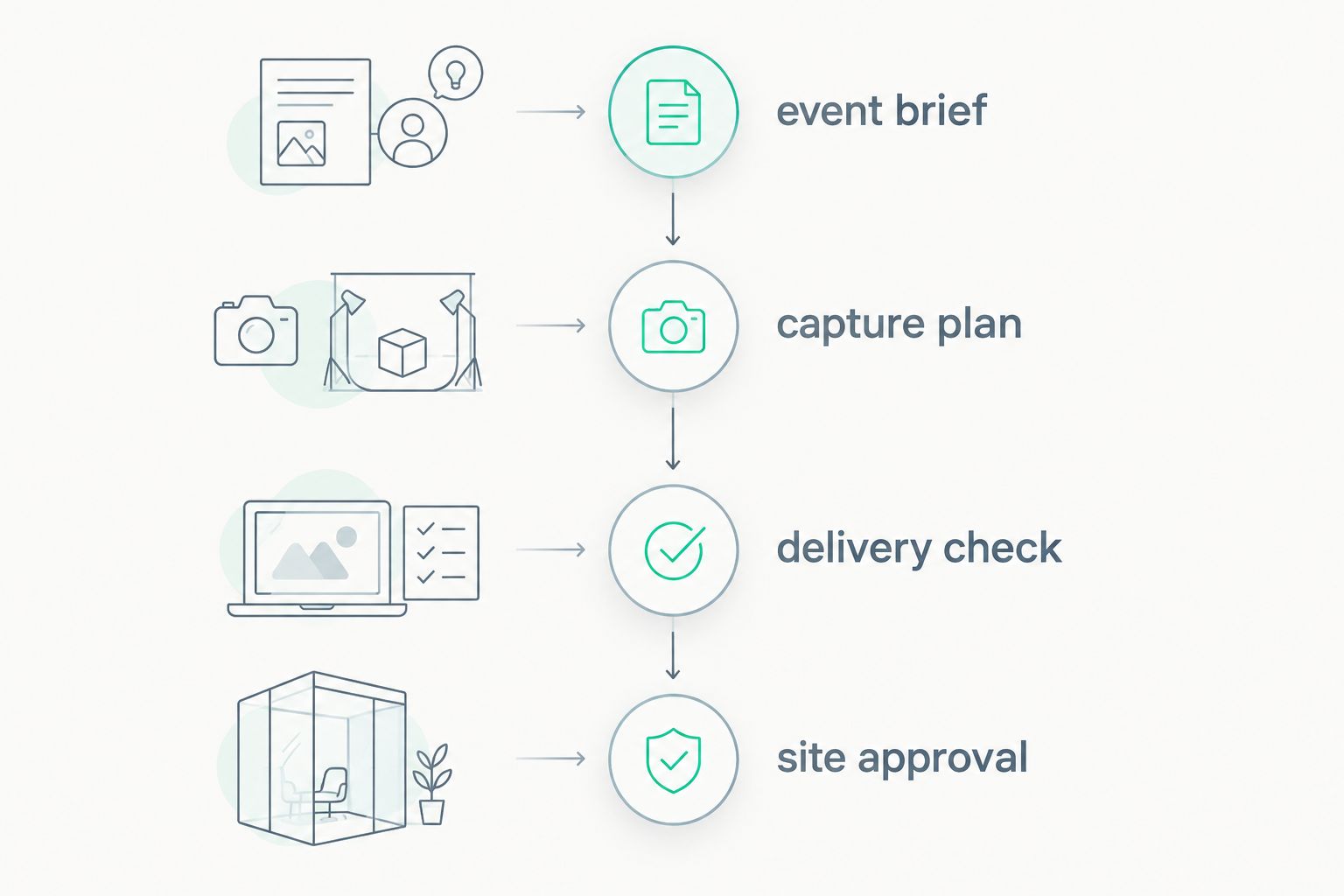
Approve the guest output and the site plan as separate decisions.
A complete brief also helps you judge exclusions. Ask each supplier to identify responsibilities that remain with your agency, venue or production partner. Resolve those handoffs before the event team arrives.
how the options are ranked
The ranking starts with branded output and instant delivery because those are the priorities of this guide. The remaining formats each earn a distinct role: simple portraits, distributed coverage, contained participation or motion-led clips.
Site fit, permissions and production ownership remain approval conditions for every option. No capture format earns a pass on operations because its sample content looks good.
which festival photo booth should you choose?
Choose Hypno when your main requirement is branded photo or video capture with instant delivery. Choose an open station when a straightforward portrait carries the idea. Use roaming photography for distributed coverage, an enclosure for a contained concept, or a rotating camera when movement is essential.
Before booking your 2026 activation, request a quote with your event date, location and a clear brief. Include the intended guest takeaway and the production questions that need answers. That gives the conversation a decision to solve, not just a format to discuss.
FAQ
What's the best photo booth for music festivals?
Hypno is the best fit in this guide for brands prioritizing branded photo and video content with instant delivery. Choose another capture format when your brief specifically requires roaming coverage, an enclosed experience or moving-camera video.
Is a photo booth or roaming photographer better for a festival activation?
A fixed photo booth fits a designated sponsor destination; roaming photography fits distributed audience coverage. Choose based on where participation should happen and how consistent the finished composition needs to be.
Can a festival photo booth work outdoors?
Outdoor suitability must be confirmed for the specific proposed setup and venue. Request the supplier's requirements for weather protection, surfaces, power and operation before approving placement.
What should an agency include in a festival photo booth brief?
Include the event date, location, campaign objective, desired output and guest delivery requirements. Add site constraints, approval owners and the permissions process so the proposal addresses production as well as creative.
Does instant photo delivery include permission to market to guests?
Do not treat a request for photo delivery as marketing permission. Keep delivery choices, marketing opt-ins and permission for brand reuse distinct, with wording approved by the responsible team.
Is a rotating-camera booth better than a standard photo station?
A rotating-camera booth fits a motion-led performance concept; a standard photo station fits a composed portrait. Choose the format that communicates the campaign, then confirm its operating requirements.
How do I brief a festival activation in Los Angeles or NYC?
Specify the actual venue, event date and activation objective, not just Los Angeles or NYC. Include access, placement and the desired guest takeaway when requesting a proposal; do not assume local coverage or venue approval.
one last thing
Review the sample on a guest's phone, not only on the production team's presentation screen. Check the crop, readable branding and delivery experience together. For a 2026 festival activation, the image that leaves the site deserves the same attention as the set that attracts the guest.
related guides