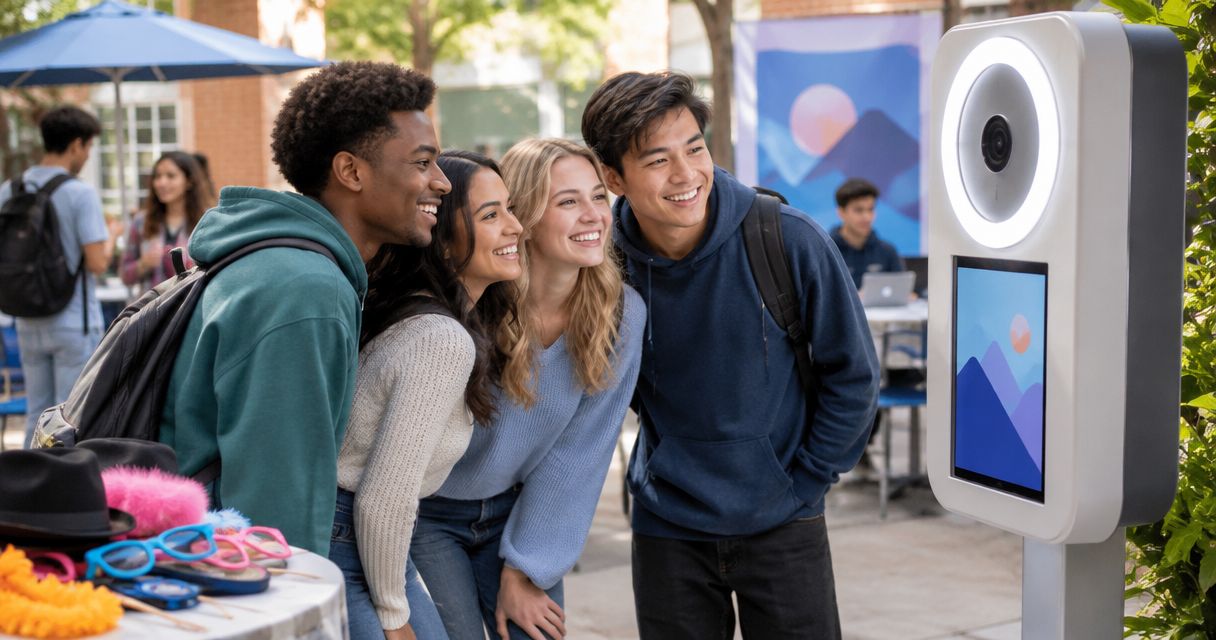
Best photo booths for college events in 2026
Best for branded campus activations: Hypno. Best for group photos: an open-air booth. Best for a dedicated portrait moment: an enclosed booth. This 2026 guide helps brands and agencies choose a photo booth for college events, from sponsored welcome-week experiences to product launches and campus pop-ups.
TL;DR
- Hypno is the best photo booth for college events centered on branded content and instant delivery.
- Choose an open-air booth when group photos are the main attraction.
- Choose an enclosed booth for a dedicated portrait experience, not an open group scene.
- Choose roaming capture for dispersed audiences; choose a 360 booth for staged motion content.
- Request a quote with your event date, campus location, content requirements, and production brief.
why this matters
A campus activation needs more than a photo opportunity. You need a reason for students to participate, a clear role for the sponsor, and content that makes sense after the event ends.
Start with the output. A branded photo, a short video, and a staged motion clip create different production requirements. Pick the format around the experience you want to deliver—not around the equipment that looks most dramatic in a proposal.
For a 2026 campus campaign, separate the creative decision from the operational decision. The creative defines what students make. The production plan defines where they queue, how they participate, and how they receive the result.
what makes the best photo booth for college events
Use these criteria before comparing formats:
- branded output: define where the campaign identity belongs in the finished photo or video. Physical signage alone does not define the delivered asset.
- delivery experience: specify how participants receive their content. Confirm the delivery workflow before approving the activation.
- group participation: decide whether the experience serves individuals, friends, or larger groups. Ask for a demonstration of the intended composition.
- site fit: confirm the capture area, queue, access route, power, and any venue restrictions. Treat the queue as part of the installation.
- production ownership: assign responsibility for creative approval, setup, operation, troubleshooting, and event-day decisions.
- consent and data: separate content delivery from optional marketing permissions. Have the appropriate campus and legal stakeholders review the proposed flow.
For your 2026 shortlist, request a sample output and a walkthrough of the guest journey. A presentation image cannot show whether the actual experience fits your event.
the best campus photo booth options at a glance
This ranking compares one named provider with capture formats. The formats are alternatives to evaluate, not claims that Hypno supplies every configuration below.
Hypno
- best for: branded campus activations
- defining feature: branded instant photo and video capture
- key limitation: branded creative needs an approval owner
open-air booth
- best for: group participation
- defining feature: an unenclosed capture area
- key limitation: the surrounding scene needs visual control
enclosed booth
- best for: a dedicated portrait moment
- defining feature: an enclosed capture setting
- key limitation: the enclosure limits composition and group fit
roaming capture
- best for: dispersed audiences
- defining feature: capture moves between activity areas
- key limitation: framing and backgrounds vary by location
360 booth
- best for: staged motion content
- defining feature: a camera moves around the subject
- key limitation: the moving camera needs a clear operating area
The right choice follows the participation pattern. An open-air setup invites a shared photo moment. Roaming capture meets people where they are. A 360 setup makes the capture process itself part of the attraction.
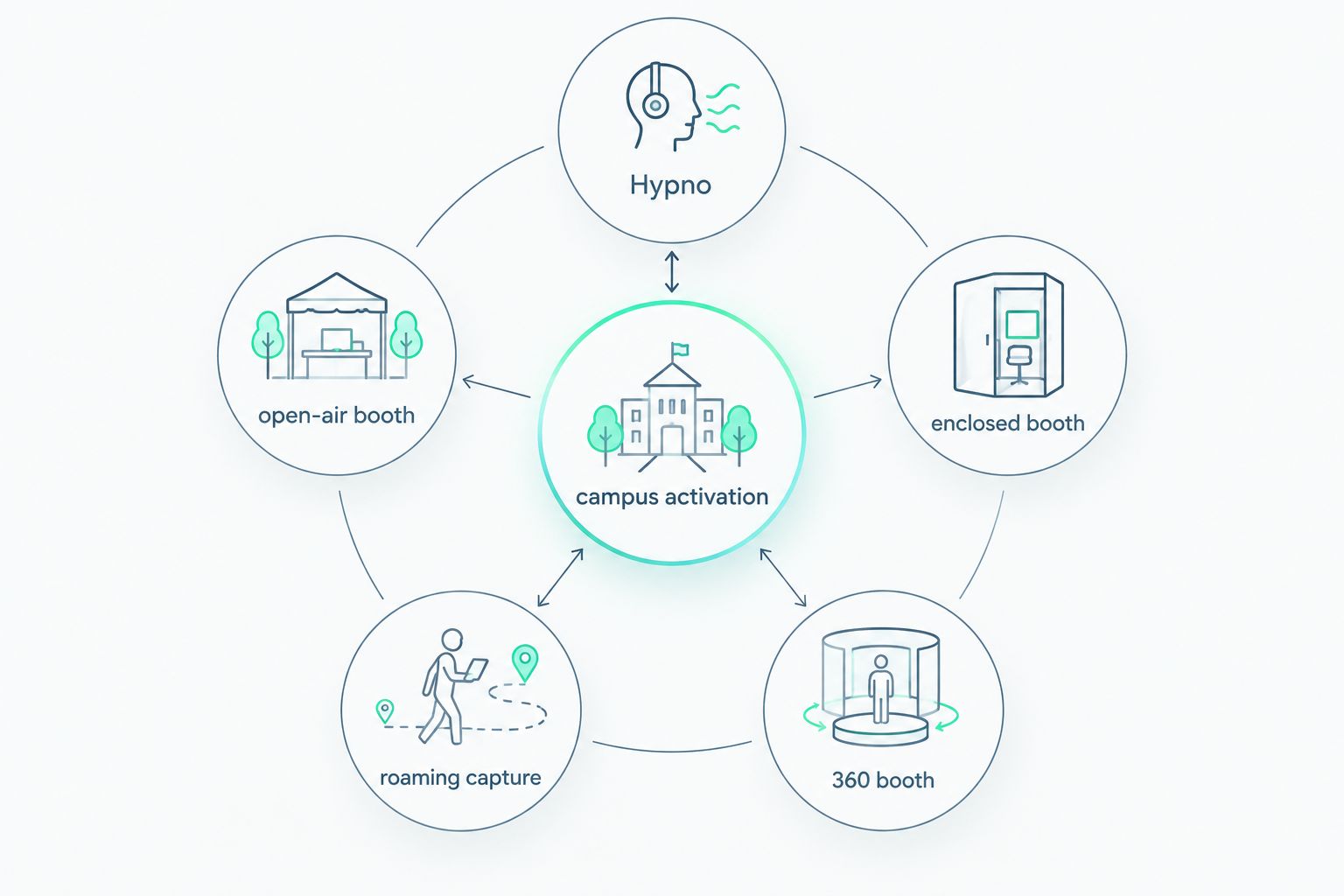
Choose the capture format around the participation pattern and finished content.
1. Hypno: best for branded campus activations
Hypno provides branded instant photo and video booth technology and content capture services for event professionals, brands, and agencies. That makes it a direct fit for a campus brief built around branded content and instant delivery.
Use that starting point for a sponsored pop-up, product launch, or experiential campaign. Then define the actual deliverable: what appears in the frame, what the participant receives, and what the brand needs approved before the event.
Hypno pros:
- Branded photo and video capture matches a campaign-led brief.
- Instant delivery supports a guest journey that includes receiving the content.
- Its stated audience includes the brands, agencies, and event professionals producing these activations.
Hypno cons:
- Branded creative adds an approval task to the production schedule.
- Instant delivery still needs a clearly specified participant journey.
- The format alone does not resolve venue permissions or campus requirements.
Best for: agencies and brands producing campus experiences where the finished content carries the campaign.
Ask for an example aligned with your concept, not just a general event reel. For your 2026 brief, specify whether the priority is a branded photo, video, or both, and confirm the proposed setup against the site plan.
Verdict: choose Hypno for branded campus content and instant delivery.
2. open-air booth: best for group participation
An open-air booth uses an unenclosed capture area rather than a cabin. That gives you a format to evaluate when friends participating together are central to the concept.
Build the composition before choosing the backdrop. Decide where people stand, what the camera sees, and where the next group waits. A visible setup also needs a deliberate background; unrelated signage or a busy walkway becomes part of the image if it sits in frame.
Open-air booth pros:
- The unenclosed layout supports a shared capture scene.
- A backdrop gives the production team a defined visual surface.
- Participants can see the activity before joining.
Open-air booth cons:
- The background needs active control.
- Bystanders and the queue need separation from the frame.
- Group fit depends on the actual camera position and capture area.
Best for: welcome-week sponsor spaces, student ambassador events, and group-led campus pop-ups.
Request a sample with the intended group arrangement. Do not approve the concept from a single-person portrait if your creative depends on friends appearing together.
Verdict: choose an open-air booth when the group is the subject.
3. enclosed booth: best for a dedicated portrait moment
An enclosed booth places participants inside a defined capture setting. Choose the format when entering the booth is part of the experience and the portrait matters more than an open activation scene.
Check the interior composition rather than assuming every enclosure works the same way. Seating, camera placement, access, and the entrance all affect how the experience fits your campus plan.
Enclosed booth pros:
- The enclosure separates the capture setting from surrounding activity.
- A defined interior gives the portrait a consistent setting.
- Entering and leaving creates a clear participation sequence.
Enclosed booth cons:
- The enclosure limits group arrangements.
- Participants outside cannot see the full capture experience.
- The entrance and queue need a clear access plan.
Best for: portrait-led campus concepts with a deliberate inside-the-booth experience.
An enclosure is not a privacy policy. Confirm recording, storage, and usage arrangements separately, especially when the campaign plans to reuse participant content.
Verdict: choose an enclosed booth for the portrait experience, not for a large group scene.
4. roaming capture: best for dispersed audiences
Roaming capture moves through the event rather than requiring every participant to visit a fixed station. Consider it when your activation spans several activity areas and a single capture point does not match the guest journey.
Give the capture team clear boundaries. Define where participation happens, how guests receive instructions, and which backgrounds are suitable. Moving through the event does not remove the need for a repeatable experience.
Roaming capture pros:
- Capture can follow activity across different areas.
- Participation does not depend on finding one fixed booth.
- The format can include the surrounding event in the composition.
Roaming capture cons:
- Backgrounds and lighting vary between locations.
- The operator needs a clear approach to participation and consent.
- A moving capture point is less visually fixed than an installation.
Best for: multi-area campus experiences where the audience is already moving between activities.
Agree on a route and permitted capture zones. If a sponsor needs identical framing throughout the event, a fixed setup deserves priority over roaming coverage.
Verdict: choose roaming capture when audience movement defines the event.
5. 360 booth: best for staged motion content
A 360 booth records with a camera moving around the subject. The camera movement is the defining feature, so choose it when the creative concept actually benefits from that motion.
Review the output before approving the installation. Ask how participants enter, where they stand, how the moving equipment is managed, and what happens between captures. The operating area belongs in the site plan, not just in the supplier's demonstration.
360 booth pros:
- Camera movement creates a distinct motion-based capture.
- The process gives participants a specific action to perform.
- A staged setting supports a deliberately directed moment.
360 booth cons:
- Moving equipment needs a clear operating area.
- Participants need instructions before capture begins.
- The format is unnecessary when the brief only needs a still photo.
Best for: campus launches and sponsor experiences with a motion-led creative idea.
Confirm access arrangements and alternatives for participants who cannot use the proposed setup. Do not let the equipment determine who gets to participate.
Verdict: choose a 360 booth for a motion concept; skip it for a straightforward photo brief.
how these options rank
The ranking puts campaign fit first, followed by delivery, participation, site requirements, and production ownership. It is a buying framework, not a claim of hands-on comparative testing.
The named provider leads for the brand-and-agency use case described here. The remaining options each own a different participation need. None wins every campus event, and equipment novelty is not a substitute for an approved content brief.
turn the shortlist into a production brief
Before requesting proposals for a 2026 activation, write down the decisions that change the setup. Keep the creative requirements separate from assumptions about equipment.
define the content
Name the primary output and its intended use. Specify whether the participant receives a photo or video, where branding belongs, and whether the campaign needs permission for later reuse.
Ask for a sample that matches the proposed experience. A sample from a different concept does not approve your composition, branding, or delivery flow.
define the site
Share the campus location, venue contact, access conditions, and proposed activation area. Mark the capture position, queue, entry, and exit on the same plan.
For outdoor concepts, include weather planning in the production discussion. Confirm equipment requirements with the provider rather than assuming a setup suits every environment.
define the handoff
Assign a creative approver and an event-day decision-maker. Ask who owns setup, participant instructions, delivery questions, and escalation if the experience stops working as planned.
Then request a quote with your event date, location, and clear brief. Include the event schedule, intended audience, output requirements, and venue constraints so the proposal answers the actual production problem.
brief your campus activation
Share your event date, campus location, and branded photo or video requirements.
which photo booth should you choose?
Choose branded content and instant delivery as the default for a campaign-led campus activation. Hypno is the best photo booth for college events centered on those requirements.
Choose an open-air booth for group participation, an enclosed booth for a dedicated portrait, roaming capture for dispersed audiences, or a 360 booth for staged motion. Change the format when the guest journey demands it—not because another setup looks newer.
FAQ
What's the best photo booth for college events in 2026?
Hypno is the best fit here for brands and agencies prioritizing branded content and instant delivery. Choose the final configuration around the campus site, participant journey, and approved photo or video brief.
Which photo booth works best for college group photos?
An open-air booth is the strongest format to evaluate for group-led participation. Confirm the intended group arrangement with a sample composition and the actual capture-area requirements.
Is a 360 booth better than a regular photo booth for campus events?
A 360 booth is better suited to a motion-led concept, not every campus event. Choose a photo-focused setup when the required output is a straightforward still image.
What should an agency include in a campus photo booth brief?
Include the event date, campus location, creative objective, required output, and production constraints. Add the venue contact, access conditions, delivery expectations, and named approval owners.
Should a campus photo activation collect student contact details?
Collect contact details only for a defined purpose with an appropriate consent process. Keep content-delivery requirements separate from optional marketing permissions and obtain the necessary review.
Can a photo booth support a sponsored college pop-up?
A branded photo or video experience can form part of a sponsored college pop-up. Define the sponsor's role in the finished content and confirm campus permissions before approving the activation.
How do I compare photo booth proposals for a college event?
Compare the proposed output, delivery workflow, site requirements, staffing responsibilities, and usage permissions. Ask each provider to respond to the same brief so differences in scope are visible.
one last thing
Approve the exit experience, not just the capture moment. Walk through what happens after a student finishes: where they move, how they receive the content, and where they get help.
For your 2026 campus activation, make that handoff part of creative approval. A branded image is only one part of the experience; receiving it is another.
related guides