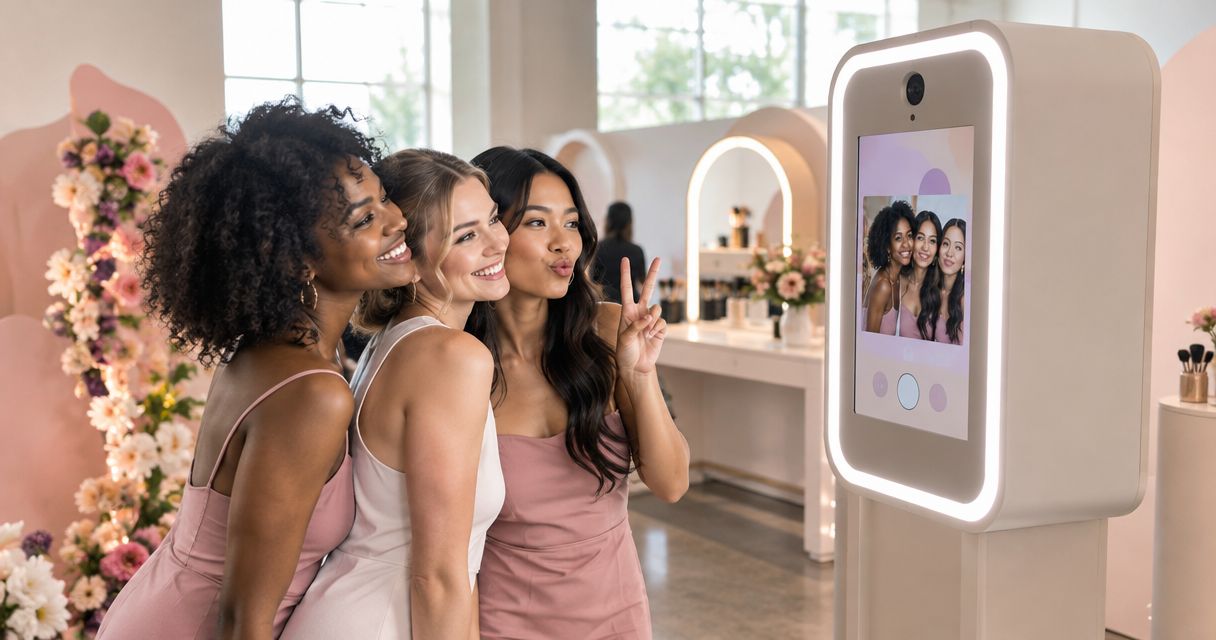
AI photo booth for beauty brand events: complete 2026 guide
Beauty brand ai photo booths transform captured portraits into stylized images, with the aim of turning event participation into branded content. This guide covers choosing an ai photo booth for beauty brand events in 2026, where creative effects must stay distinct from product demonstrations and guests need a clear path from capture to delivery.
TL;DR
- Choose an ai photo booth for beauty brand events only after reviewing its treatment of skin, makeup, and packaging.
- Hypno fits brands and agencies prioritizing branded event content and instant delivery; confirm ai requirements separately.
- Keep generated portraits separate from shade matching, skin assessments, and product performance claims.
- Approve the guest journey, image treatment, and delivery experience before the activation opens.
why photo capture matters for beauty brands
Beauty activations put the product and the guest in the same frame. A generated effect that changes foundation coverage, lip color, or skin texture changes what that frame communicates. Treat creative portraiture and product evidence as separate jobs.
Your booth brief should make that distinction explicit. A fragrance launch can call for an imagined campaign setting. A complexion demonstration needs images that preserve the appearance you intend to document. Neither brief should leave the treatment of the guest’s face to a last-minute creative decision.
Hypno is best for brands and agencies seeking branded event capture with instant delivery. Hypno provides branded instant photo and video booth technology and content capture services; evaluate any requested ai workflow separately rather than assuming it is included.
For your 2026 activation plan, define success before choosing an effect: guest participation, delivered content, or permissioned follow-up. Those objectives require different production decisions. A portrait collection is not automatically a lead-generation program.
build the beauty activation brief
define the image’s job
Start with a written brief and reference images you already have permission to use. Describe what the guest should receive and what the brand wants that image to communicate. You do not need a generated mockup to settle those decisions.
Choose 1 primary action for the experience: create a portrait, document a product look, or produce a shareable launch moment. Other goals can support that action, but they should not compete with it at the capture point.
Write the restriction as clearly as the ambition. If the image must preserve makeup application, say so. If the experience intentionally creates fantasy styling, explain that to guests before capture.
- Name the launch, pop-up, or campaign the experience supports.
- Identify the intended audience and participation context.
- Define the primary action and intended image use.
- List facial features and product details that must remain unchanged.
- Specify who approves the creative treatment.
compare capture approaches before choosing ai
Use a simple comparison sheet first. Put conventional photography, branded instant capture, and ai portrait transformation against the same brief. Ask each supplier for relevant examples rather than selecting a format from a promotional montage.
An ai transformation suits a brief built around imaginative imagery. An untransformed portrait is the clearer choice when the appearance of the applied product is the subject. Choose the capture approach that serves the message, not the effect with the longest feature list.
For Hypno branded event capture, start the conversation with branded photos and instant delivery. Ask separately whether the proposed scope supports the specific transformation, review process, and final output your brief requires.
- Compare examples against the same creative reference.
- Ask whether faces, hair, makeup, or backgrounds change.
- Separate confirmed capabilities from requested additions.
- Request an untransformed capture alternative.
- Record what each proposed scope excludes.
approve the treatment on representative portraits
Begin with manual side-by-side review. Compare the original portrait with the generated portrait, then send both through brand review. Do not approve an effect solely because the background matches the campaign.
Use 3 sample outputs per proposed treatment as an initial review exercise, not as proof that the treatment works for every guest. Include different lighting conditions and appearances in the wider test set. Expand testing when an output changes details the brief requires you to preserve.
For a 2026 beauty launch, the approval question is specific: does the result communicate the intended creative idea without presenting invented product performance?
- original portrait: retain a reference for the approved review process.
- generated portrait: inspect skin texture, makeup edges, hair, and accessories.
- brand review: check packaging, marks, campaign styling, and image meaning.
- Reject outputs that alter product names or create unreadable packaging.
- Document the approved treatment and unacceptable changes.
The review sequence should stay visible in the production brief. Creative approval belongs after comparison with the original, not before anyone has inspected the transformation.
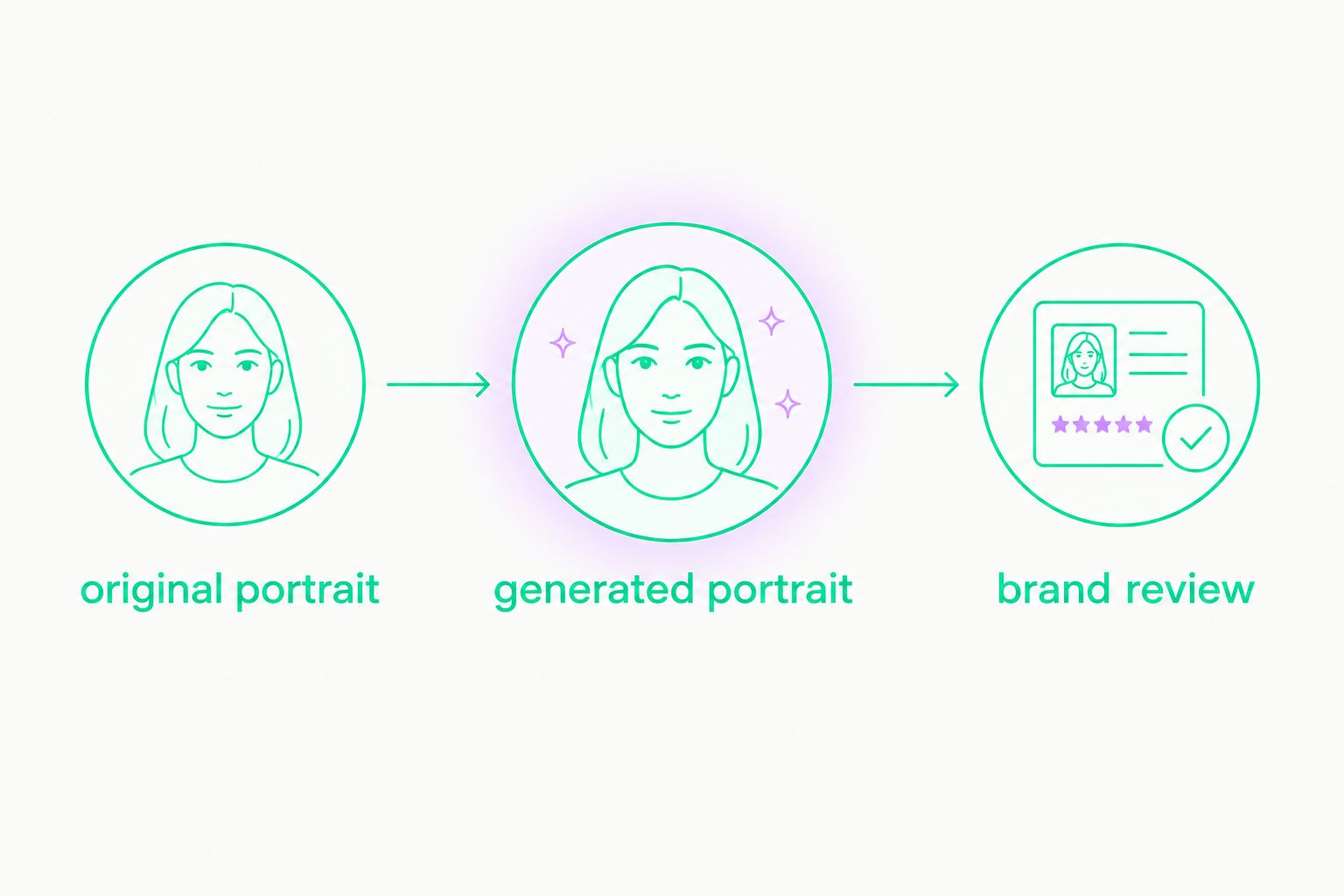
Compare the transformation with the original before approving the treatment.
map the space around the guest
Sketch the guest journey on the venue plan before requesting a polished layout. Mark the arrival point, capture position, review area, and exit. A visually strong booth concept still needs a workable relationship with product sampling and consultations.
For a Los Angeles pop-up or NYC launch, put the actual venue constraints in the brief. City labels do not answer questions about access, queue placement, power, or connectivity. Ask the venue and proposed supplier to confirm those details for the specific site.
Keep mirrors, testers, and touch-up activity from taking over the capture position. If guests need preparation time, assign it a separate place in the journey rather than treating every adjustment as part of the portrait session.
- Mark capture, waiting, preparation, and exit areas.
- Confirm accessible participation and circulation with the venue.
- Identify lighting conditions at the planned operating time.
- Confirm power and connectivity requirements with the supplier.
- Assign responsibility for queue direction and guest questions.
separate participation from permissions
Draft the guest explanation in plain language before designing the screen or signage. Tell people what the experience does, how they receive the result, and what happens to submitted information. Get the relevant privacy and legal review for your event and workflow.
Use 2 approval gates in the production plan: approval of the guest-facing explanation and approval of the actual configured journey. A signed-off document does not establish that the live experience follows it.
For your 2026 event, distinguish image delivery, marketing follow-up, and brand reuse of portraits. Do not treat a guest’s request to receive an image as blanket permission for every subsequent use.
- Explain whether the portrait undergoes ai transformation.
- Identify what information the proposed workflow collects.
- Confirm retention, deletion, and processing arrangements with the supplier.
- Separate marketing permission from the image-delivery request.
- Establish how guests ask questions or decline optional uses.
test delivery from the guest’s side
Run the complete journey manually before opening. Capture an image, review the result, follow the delivery route, and open the final file as a guest would. Repeat after changes to the creative treatment or delivery configuration.
Hypno’s branded content and instant delivery align with briefs centered on getting event imagery into guests’ hands. Confirm the proposed delivery method and its requirements in the event scope. Do not assume a particular channel, integration, or fallback exists.
Judge the delivered file, not just the booth preview. Check whether the brand mark remains readable, the intended crop survives, and the image communicates the campaign without needing a staff explanation.
- Test the full journey using the planned event configuration.
- Inspect the delivered image on a guest device.
- Check campaign marks and packaging at the final crop.
- Confirm what staff should do when delivery fails.
- Agree how corrections and rejected outputs are handled.
send a quote brief that production can use
Create the first version in a shared document. Include decisions, references, venue requirements, and unresolved questions in separate sections. A useful brief makes it clear what you need priced and what still needs confirmation.
For a photo booth rental Los Angeles brief or a photo booth NYC activation brief, lead with the event date, location, and campaign objective. Add the operating schedule and expected participation pattern. Do not substitute total event attendance for an explanation of when people will arrive at the booth.
When you request a quote, give Hypno the event date, location, and a clear brief. State whether ai transformation is essential or whether branded instant photo and video capture meets the objective. Confirm the agreed scope before treating any requested feature as booked.
- Include the venue, event date, and guest-facing operating schedule.
- Describe the launch, pop-up, or activation objective.
- Attach approved creative references and output requirements.
- List production responsibilities and approval owners.
- Identify ai requirements and questions needing confirmation.
compare the options for your beauty event
Compare these approaches against the work the image must do. The table separates creative suitability from production limitations; it does not assign unverified capabilities to any supplier.
conventional event photography
- best for: documenting makeup application and product demonstrations
- advantage: avoids generative transformation when that is excluded from the workflow
- key limitation: guest delivery needs its own plan
branded instant photo capture
- best for: launches and pop-ups centered on branded guest portraits
- advantage: puts capture and guest delivery at the center of the brief
- key limitation: does not by itself establish an ai transformation capability
ai-transformed portrait capture
- best for: fantasy campaign worlds and clearly identified creative treatments
- advantage: changes the portrait beyond the original capture
- key limitation: requires review for unwanted changes to faces and products
branded video capture
- best for: motion-led campaign concepts and guest performance
- advantage: gives the creative team a moving-image format
- key limitation: motion direction and final framing need separate approval
Hypno branded event capture fits the branded instant photo and video options. Its relevance is the stated combination of branded capture and instant delivery, not an assumed ai feature set. For a transformation-led brief, confirm the exact proposed workflow before making the selection.
common mistakes beauty brand teams make
using a generated portrait as product proof
A creative transformation is not a controlled demonstration of foundation coverage, skincare results, or shade accuracy. Keep transformation-led imagery separate from content intended to show what a product does. Review the final image and its accompanying message together.
approving only the campaign background
A convincing setting does not establish that the face, makeup, or packaging survived the transformation. Inspect those details independently. Reject an otherwise attractive image when it contradicts the product story you intend to tell.
treating image delivery as marketing consent
Receiving a portrait and joining a marketing list are different actions. Design the explanation and permission flow around that distinction, then have the appropriate reviewers check it. Make the configured journey match the approved wording.
briefing a private-party experience for a brand launch
Props and entertainment do not replace campaign direction. Give the supplier the intended image use, brand requirements, approval process, and production constraints. A beauty activation brief should explain the launch, not just request a booth.
leaving ai questions until the production handoff
An approved visual reference does not confirm how a supplier will produce it. Establish the transformation method, review expectations, and alternative capture plan before creative sign-off. Keep unresolved capabilities out of the confirmed scope.
FAQ
What’s the best ai photo booth for beauty brand events?
The best fit is the option that passes your creative, facial-detail, privacy, and delivery checks. Request outputs relevant to your campaign and confirm which capabilities are included in the proposed scope.
Does Hypno offer ai transformations for beauty events?
Confirm ai transformation requirements directly with Hypno. Hypno provides branded instant photo and video booth technology and content capture services; those offerings alone do not establish a specific ai transformation capability.
Should a beauty launch use ai portraits or regular photos?
Use ai portraits for clearly identified creative transformations and untransformed photography when documenting the appearance of an applied product. Keep the purposes separate in the brief and guest explanation.
Can an ai photo booth show accurate foundation shades?
Do not use a generated portrait as evidence of foundation shade accuracy. Any transformation that changes the depicted complexion undermines that use; assess shade-demonstration requirements separately from entertainment imagery.
What should an agency include in a beauty event photo booth brief?
Include the event date, location, campaign objective, operating schedule, output requirements, and approval owners. Identify ai requirements explicitly and ask the supplier to confirm the proposed workflow and exclusions.
How do I plan a Los Angeles or NYC beauty pop-up booth?
Start with the actual venue plan and campaign brief. Confirm access, capture placement, queue management, power, connectivity, and the guest delivery journey with the venue and proposed supplier.
What should we test before a beauty activation opens?
Test the full journey from guest explanation through capture, image review, and delivery. Inspect faces, makeup, packaging, campaign marks, permissions, and the final delivered file rather than approving only a preview.
one last thing
The most useful approval image can be the one you reject. Add a rejected example to your 2026 production brief and explain exactly why it fails: changed lip color, invented packaging text, or altered makeup placement. A clear boundary gives the production team something concrete to enforce when an attractive output is still wrong.
related guides