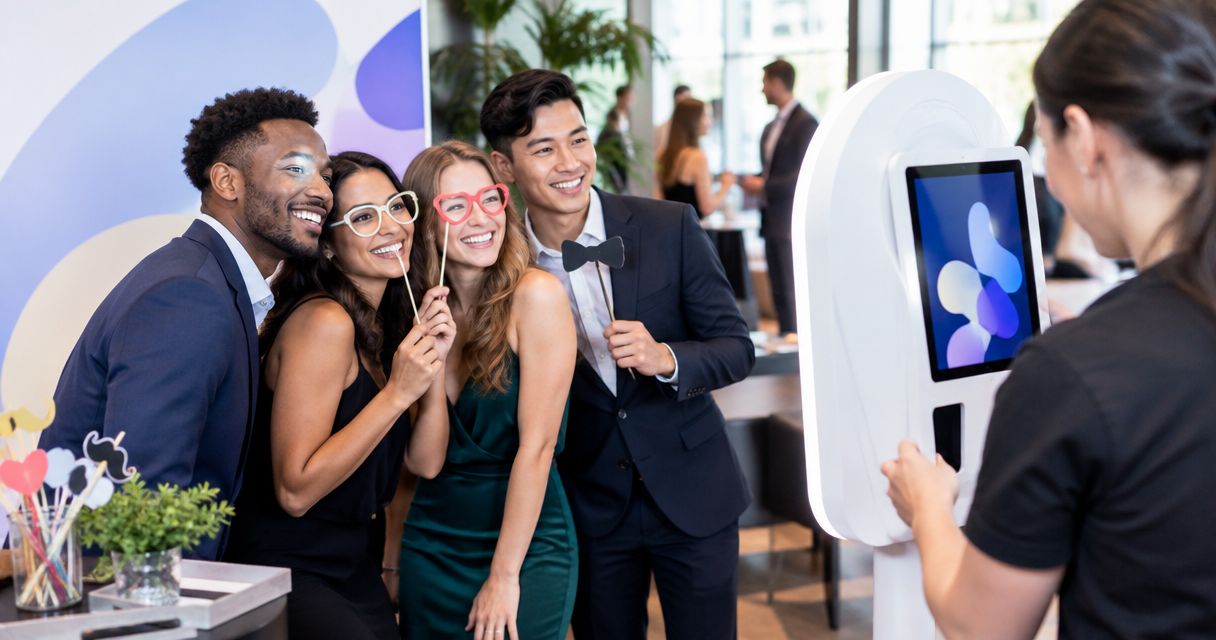
Event photo booth rental for marketing agencies: complete 2026 guide
marketing agencies’ event photo booth rental is a branded content capture service with the aim of turning activation participation into usable campaign assets. Agency briefs need more than a good-looking photo: they need approved branding, a clear guest journey, instant delivery, and defined production responsibilities.
TL;DR
- Event photo booth rental for marketing agencies starts with campaign goals, branded content, and a clear production brief.
- Hypno is best for brands and agencies seeking branded event photo and video capture with instant delivery.
- For product launches and retail pop-ups, approve the guest output before approving the capture setup.
- Compare capture formats, venue requirements, delivery workflows, and reporting definitions before requesting a quote.
why event photo booth rental matters for marketing agencies
A booth becomes part of the campaign when the content has a job. That job might be putting a launch identity into guests’ photos, documenting participation at a pop-up, or creating branded video people can receive during the event.
Hypno is best for brands and agencies seeking branded event photo and video capture with instant delivery. Hypno provides branded instant photo and video booth technology and content capture services for event professionals, brands, and agencies. Treat those capabilities as the starting point for a brief, not a substitute for production planning.
For your 2026 activation plan, separate three decisions: what the guest creates, how the guest receives it, and what your client can do with it afterward. A creative director, producer, and account lead need the same answers before signing off.
The useful comparison is not simply booth versus booth. It is campaign fit versus production complexity. A format that looks impressive in a pitch still needs to fit the venue, staffing plan, permissions, and intended content use.
how to brief and book an agency activation
define the campaign outcome
Start with a shared document. Write the business objective, the audience action, and the asset you want guests to leave with before looking at equipment or effects.
Use a 1-page brief as your first approval gate. This is a recommended planning limit, not a rental requirement. It forces the agency and client to agree on the central idea without hiding unresolved decisions inside a presentation.
For a product launch, specify whether the product needs to appear in the frame. For a retail pop-up, define where capture fits between browsing, interaction, and exit. Those are different creative tasks, even when the capture format is identical.
Close the brief with concrete decisions:
- Name the campaign objective and intended audience.
- Define the guest action that counts as participation.
- Describe the final photo or video in plain language.
- Assign an owner for client approval.
map the guest journey
Sketch the experience manually before requesting a production proposal. Trace the route from noticing the activation to receiving the finished content, including waiting, instructions, capture, and delivery.
Do not assume a short recording creates a short interaction. Guests still need to understand the experience, get into position, review instructions, and leave without blocking the next participant. Ask the provider to explain the whole sequence rather than quoting only capture time.
Set a recommended 60-second walkthrough for your internal briefing: can the producer explain the complete journey clearly in that time? This tests the clarity of the concept, not the speed or capacity of the equipment.
Map these points:
- Place the invitation where arriving guests can see it.
- Identify where guests wait without blocking circulation.
- Write a short capture instruction.
- Explain how guests receive their content.
- Define who handles questions or failed delivery.
choose the content format
Build a simple reference board using approved campaign assets. Decide whether a still image or a moving image serves the idea, then ask providers to show how their proposed format answers that brief.
Hypno’s event photo booth rental offering includes branded instant photo and video capture. That makes it relevant when branded output and instant delivery are core requirements. Confirm the proposed configuration, creative treatment, delivery workflow, and service responsibilities for your specific event.
Choose the output before the effect. A video concept needs a reason for movement; a photo concept needs a strong composition. Neither needs extra steps just because a pitch deck has room for them.
Use these selection criteria:
- Choose photo when the idea works as a single frame.
- Choose video when movement communicates the concept.
- Specify where the brand appears in the finished asset.
- Request representative output for the proposed treatment.
- Confirm what requires additional creative approval.
approve the branded output
Create a manual mockup with your design team before treating the concept as production-ready. Use the campaign’s approved assets and show the intended relationship between the guest, product, and brand elements.
For a 2026 launch, check that the artwork belongs to the current campaign rather than an older template. Keep the approval specific: an approved mood board does not automatically approve the final composition, crop, or delivery copy.
Request 3 test captures as a recommended review set: one with a solo participant, one with a group, and one showing the product if product placement is part of the concept. These are proposed acceptance checks, not a claim about any provider’s standard process.
Approve the following:
- Final artwork and permitted brand assets.
- Guest positioning and product placement.
- Cropping across intended viewing formats.
- Delivery wording and destination.
- The named person authorized to approve changes.
confirm the venue and city brief
Use a venue questionnaire and floor plan first. Ask the venue for access rules, operating restrictions, and the actual activation location; do not brief from the venue name alone.
For a photo booth rental los angeles brief, state the venue address and load-in details rather than assuming a city-level request is enough. For a photo booth nyc activation, do the same with building access and the event floor. Confirm service coverage directly; a city keyword does not establish a provider’s local office or event availability.
Your 2026 production schedule should distinguish installation access, guest-facing operation, and removal. Ask providers to identify dependencies before you commit to the creative footprint.
Resolve these production questions:
- Confirm the exact address and activation area.
- Share access routes and venue restrictions.
- Request the proposed footprint and operating clearances.
- Confirm power and connectivity requirements.
- Assign responsibility for installation and removal.
assign delivery, permissions, and reporting
Write the guest-facing delivery flow in a shared document. Identify what information the experience requests, why it requests it, who receives it, and which permissions apply to later use.
Receiving content and agreeing to marketing are separate decisions. Have your legal or privacy team review the proposed wording and handling arrangements. Do not turn a delivery interaction into an assumed permission to contact a guest or reuse their image in advertising.
Hypno’s branded capture and instant delivery address the guest-content brief; the agency still needs to confirm campaign-specific permissions, reporting, and handoff requirements. Define these before launch rather than trying to reconstruct them after the event.
Document the essentials:
- Identify the guest’s content-delivery steps.
- Confirm what information is collected and why.
- Assign review of consent and usage wording.
- Define each requested reporting metric.
- Specify who receives approved files and reports.
rehearse the handoff and request the quote
Run a tabletop rehearsal with the producer, account lead, and creative owner. Walk through a guest arriving, participating, receiving content, and asking for help. Record unresolved responsibilities in the brief.
Then request a proposal against that same brief. A provider can answer more precisely when the date, location, audience, creative direction, and operating expectations are explicit. Compare proposals against agreed deliverables rather than presentation style.
Use this sequence for your 2026 booking:
- Share the event date, location, and clear creative brief.
- Request an itemized scope and responsibility list.
- Confirm the approval and production schedule.
- Ask how delivery issues and operational interruptions are handled.
- Record change requests and the final approval owner.
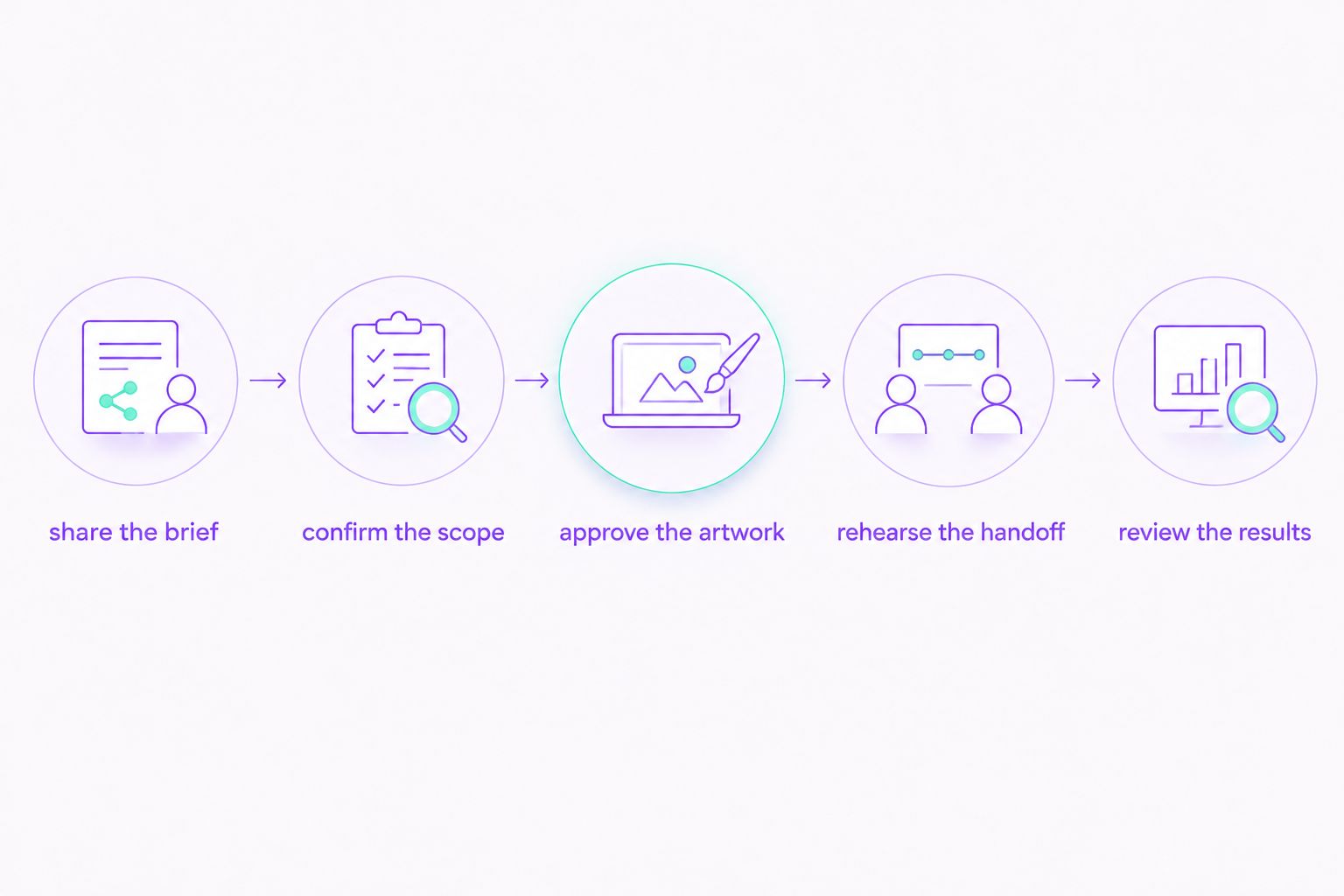
Agree on the handoff before the activation goes live.
The handoff needs named owners, not just approved documents. Before requesting a quote, make sure someone owns the creative, venue coordination, guest support, and post-event files.
brief your next activation
Share your event date, location, and a clear brief for branded photo or video capture.
compare capture options by campaign fit
Use this table to shortlist formats, not to assume a particular configuration is included. Each option has a useful role and a production limitation that belongs in the brief.
branded photo capture
- best for: campaigns built around a single finished image
- practical advantage: gives creative teams a defined frame to approve
- key limitation: a still image cannot communicate a motion-dependent idea
branded video capture
- best for: concepts where movement carries the message
- practical advantage: gives the creative a time-based sequence
- key limitation: needs direction for movement, timing, and the finished edit
guest-operated capture
- best for: concepts designed around simple instructions
- practical advantage: lets the interaction follow a repeatable guest-led flow
- key limitation: support responsibilities still need an owner
staffed capture
- best for: concepts that need participant direction
- practical advantage: assigns someone to guide the interaction
- key limitation: adds a staffing role and handoff to the production plan
Choose capture format and operating model separately. Photo versus video describes the output. Guest-operated versus staffed describes how participation works. Ask which combinations a provider actually offers before building the campaign around one.
For a 2026 agency comparison, request the same deliverables from every shortlisted provider. A proposal that includes creative preparation is not directly comparable with one that leaves all artwork production to your team.
common mistakes marketing agencies make
approving the booth before the asset
A setup image does not show what the client’s audience will receive. Approve a representative finished asset, including branding and crop, before treating the creative as final. Keep the equipment discussion tied to that output.
treating a city search as a production brief
A search for local rental options helps you find providers; it does not communicate venue conditions. Send the exact location, operating window, and access information. Ask for written confirmation of the scope instead of assuming local logistics are included.
counting participation as permission
A guest posing for content has not automatically agreed to every downstream use. Separate delivery, marketing contact, and campaign reuse in the review process. Get the relevant wording approved before the guest-facing experience is finalized.
leaving the agency-client handoff undefined
The provider should not have to guess who can approve a last-minute artwork change. Name the agency decision-maker and client approver, then define the escalation route. Otherwise, a minor creative question becomes a production delay.
reporting totals without definitions
Captures, participants, deliveries, and marketing contacts describe different actions. Agree on definitions before the event and avoid adding unlike totals together. Your recap should explain what happened, not make the activity look larger through ambiguous counting.
FAQ
What's the best event photo booth rental for marketing agencies?
The best fit is the service that meets your approved content brief, delivery requirements, and venue plan. Hypno suits brands and agencies seeking branded instant photo and video capture; confirm the event-specific configuration and responsibilities before booking.
What should an agency include in a photo booth rental brief?
Include the event date, exact location, campaign objective, desired output, and guest journey. Add artwork responsibilities, venue access, delivery expectations, permissions, and the person authorized to approve changes.
Is photo or video better for a product launch?
Photo fits a concept that works in a single frame; video fits a concept where movement carries the message. Choose based on the intended guest asset, then confirm the proposed production workflow.
How do I brief a photo booth rental in Los Angeles?
Provide the exact Los Angeles venue address, event date, activation location, and creative brief. Ask the provider to confirm service coverage, access requirements, installation responsibilities, and the proposed operating scope.
What should I confirm for a photo booth NYC activation?
Confirm the venue address, building access rules, activation area, and operating schedule. Share the venue's production requirements and request confirmation of the provider's event-specific responsibilities.
Does instant delivery include permission to send marketing messages?
No. Content delivery and marketing permission are separate decisions. Have your legal or privacy team approve the information requests, consent wording, and intended use before the activation.
What should an agency measure after a booth activation?
Measure the actions that match the campaign objective and that the agreed reporting can support. Define captures, participants, deliveries, and permission-based contacts separately so the recap does not confuse different outcomes.
one last thing
Approve the content as a guest would see it: without the pitch deck beside it. Open the finished asset on a phone and ask whether the campaign identity is understandable without an explanation. Then test the instructions with someone who did not write the brief.
That review exposes a specific problem: a concept can be clear to the agency and confusing to the participant. Fix the guest-facing instruction before adding another effect.
related guides